Bratislava
A compact Danube capital of coronation streets, a hilltop castle and Cold War concrete, with vineyards and border-castle ruins a short bus ride away.
- Best time to go
- May to June and September to October; late November for new wine and Christmas markets
- Local time
- –
- Currency
- Euro (EUR)
- Reading time
- 15 min
- Language
- Slovak
Bratislava is one of the smallest capitals in Europe and one of the easiest to enjoy. Squeezed between the Danube and the last foothills of the Carpathians, it sits right on the borders of Austria and Hungary, closer to Vienna than any other two capitals on the continent are to each other. For almost three centuries, as Pressburg or Pozsony, it was the coronation city of the Kingdom of Hungary, and its compact Old Town still carries that weight in its palaces, churches and cobbled lanes.
The city's other faces are just as memorable. Socialist-era planners drove a motorway bridge through the old Jewish quarter and hung a flying-saucer restaurant from its pylon; across the river, the vast prefab estate of Petržalka houses a good share of the population; and along the riverbank a glassy new business district has sprung up since the 2000s. Beyond the city limits come forested hills, a ruined frontier castle above the meeting of two rivers, a modern art museum on a Danube peninsula and a string of wine villages along the Small Carpathians. Most visitors give Bratislava a day trip from Vienna or Budapest; two or three nights do it far more justice.
The top 14 in Bratislava
- 1
Michael's Gate
Photo: Diego Delso, CC BY-SA 4.0, via Wikimedia Commons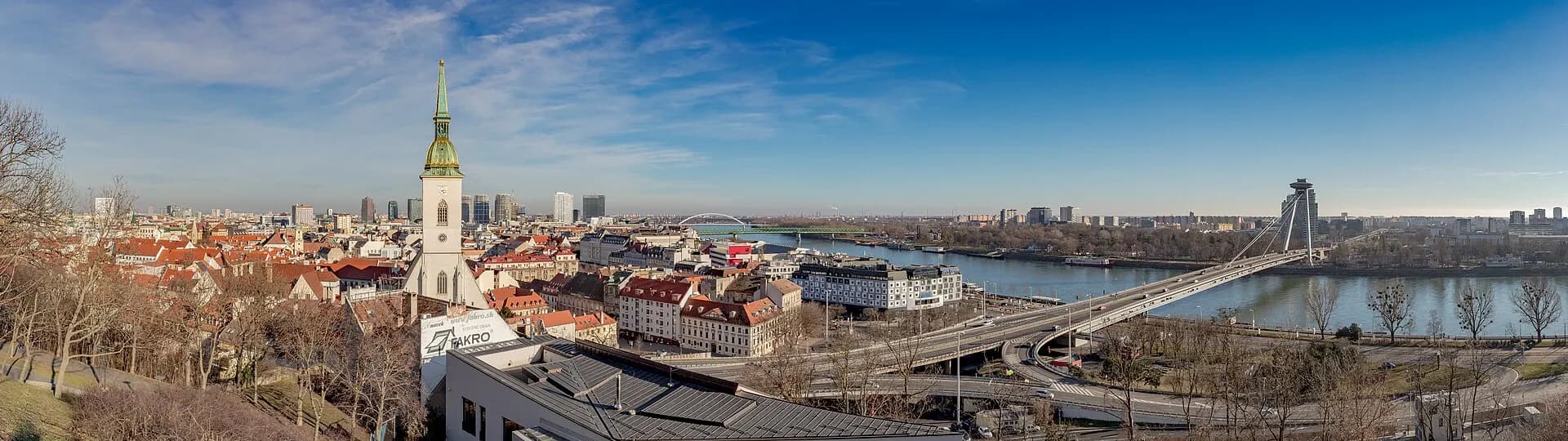
The only gate to survive from the medieval town walls makes a natural starting point. Its tower, topped since the eighteenth century by an onion-shaped baroque cupola and a statue of the Archangel Michael slaying a dragon, rises over Michalská street, the main way into the Old Town from the north. Inside, a small museum of historic weapons and town fortifications climbs to a narrow gallery with views across the red roofs to the castle and the cathedral spire. On the pavement just inside the gate, look for the brass plaque at Kilometre Zero, set with the distances to world capitals.
TipThe tower gallery is tiny and can feel crowded; go at opening time for a calmer view.
- 2
Main Square and the Old Town Hall
Photo: Pudelek (Marcin Szala), CC BY-SA 3.0, via Wikimedia Commons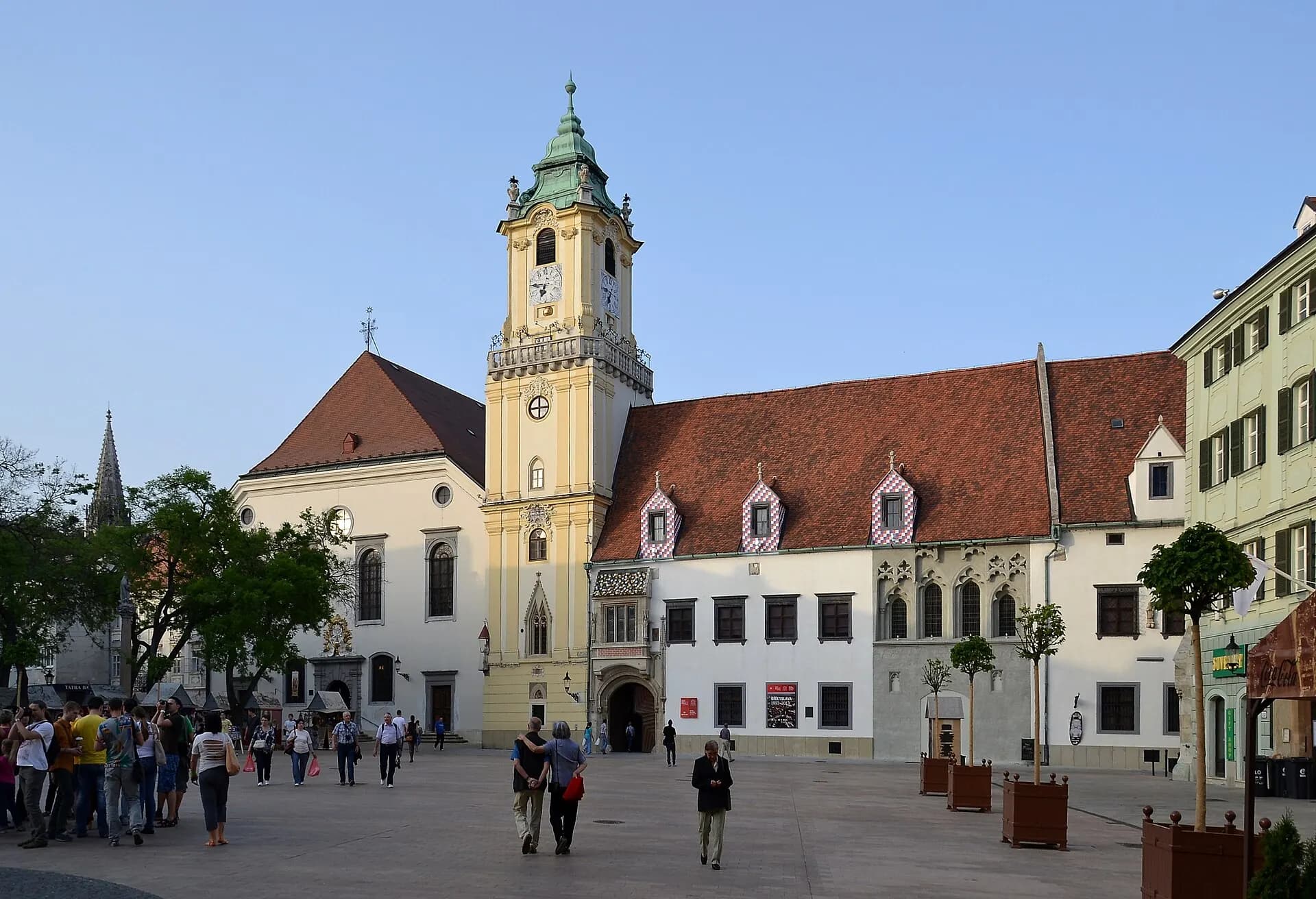
Hlavné námestie, the Main Square, is the heart of the Old Town, a small and pleasantly irregular space ringed by palaces, cafés and the Roland Fountain of 1572, built to supply the town with water and topped by a statue of a knight in armour. On its east side the Old Town Hall is a patchwork of houses joined together from the fourteenth century onwards, with a tower you can climb and a cannonball still lodged in the façade from the Napoleonic siege of 1809. It now houses the Bratislava City Museum, with exhibitions on the town's history and changing displays. Around the square and its neighbour, Františkánske námestie, you'll meet the city's whimsical bronze statues, including Čumil, a workman peering out of a manhole.
TipIn late November and December the square fills with the Christmas market, with mulled wine, punch and potato pancakes called lokše.
- 3
Primate's Palace
Photo: Diego Delso, CC BY-SA 4.0, via Wikimedia Commons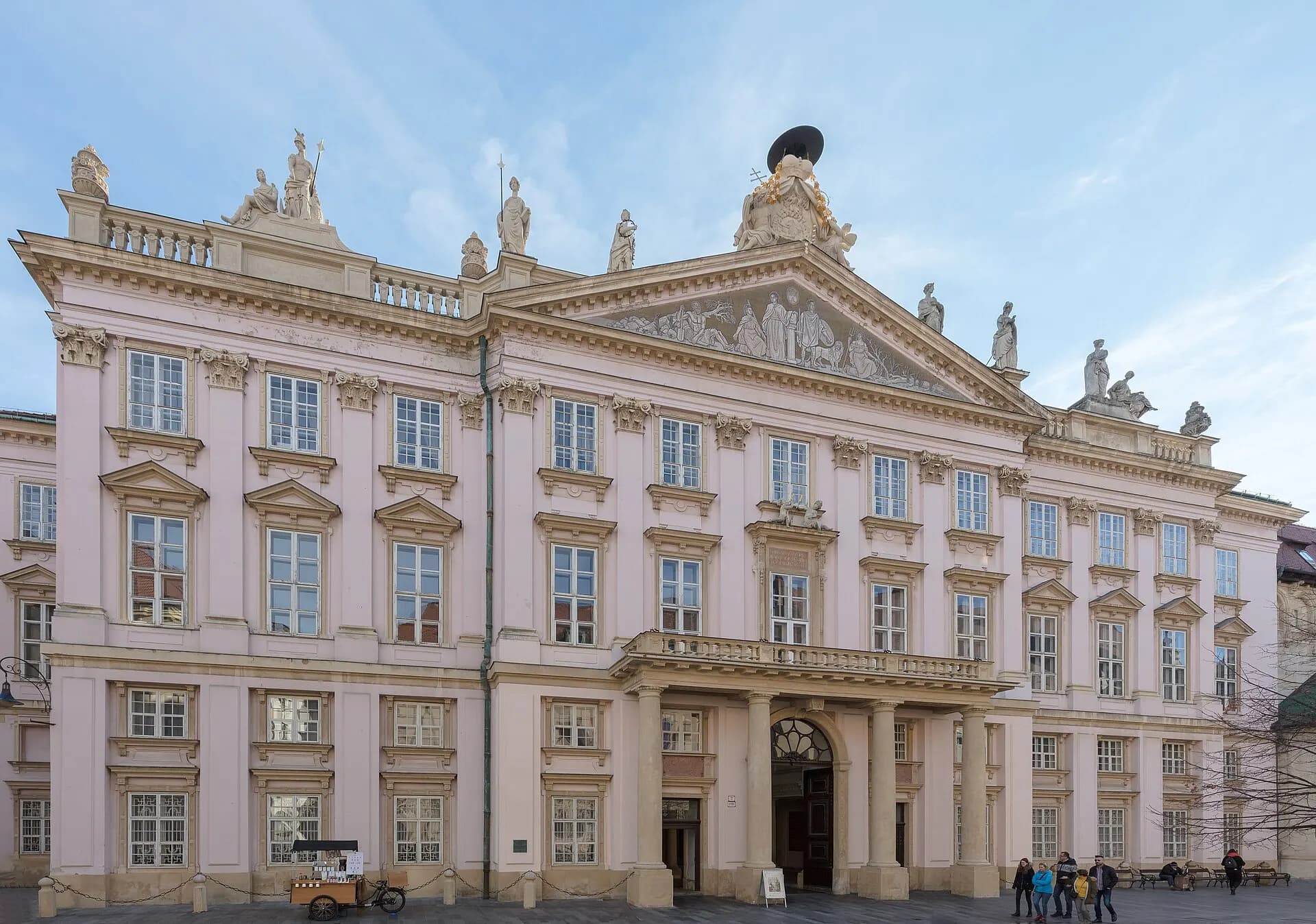
Behind the Old Town Hall stands the pale pink neoclassical palace built in the 1770s and 1780s for the Archbishop of Esztergom, the head of the Catholic Church in Hungary, whose cardinal's hat crowns the pediment. Its Hall of Mirrors is where the Peace of Pressburg was signed in 1805 after Napoleon's victory at Austerlitz. The palace's other treasure is a set of six seventeenth-century English tapestries telling the story of Hero and Leander, rediscovered hidden behind wall panelling during renovation in the early twentieth century. The building is now used by the mayor and city council, so some rooms close for official events.
- 4
Blue Church
Photo: Thomas Ledl, CC BY-SA 4.0, via Wikimedia Commons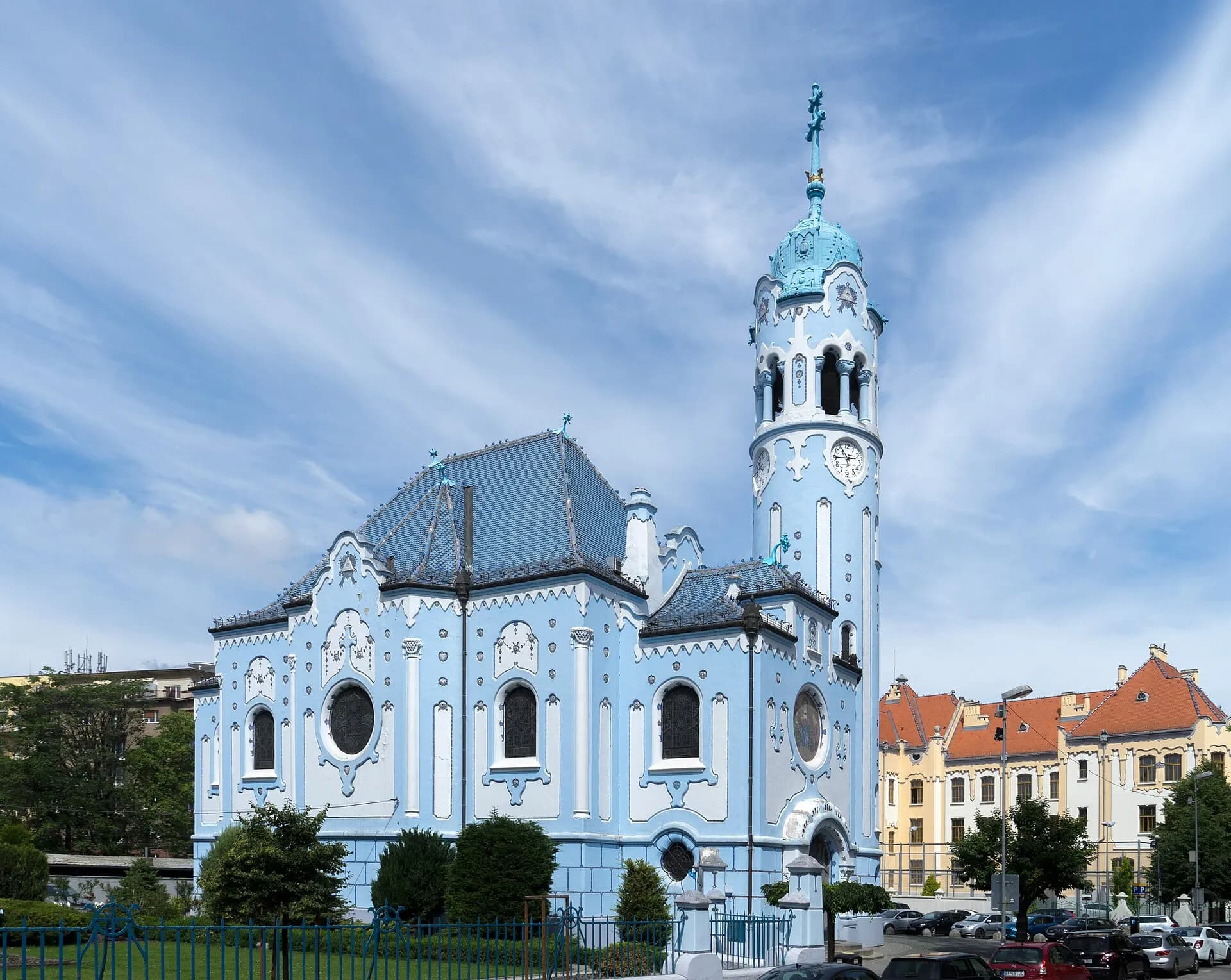
A short walk east of the Old Town, the Church of St Elizabeth looks as if it has been iced like a cake. Designed by the Hungarian architect Ödön Lechner and finished in the early 1910s, it is a jewel of Hungarian Art Nouveau: pale blue walls, blue-glazed roof tiles, mosaics, rounded mouldings and a slim round tower, with a matching school building next door. It was originally built as a chapel for the neighbouring grammar school, and inside it is just as blue. The church is usually open only around services, but the exterior alone justifies the detour.
TipThe light is best in the morning, when the sun falls on the main façade.
- 5
Danube embankment and Eurovea
Photo: kallerna, CC BY-SA 4.0, via Wikimedia Commons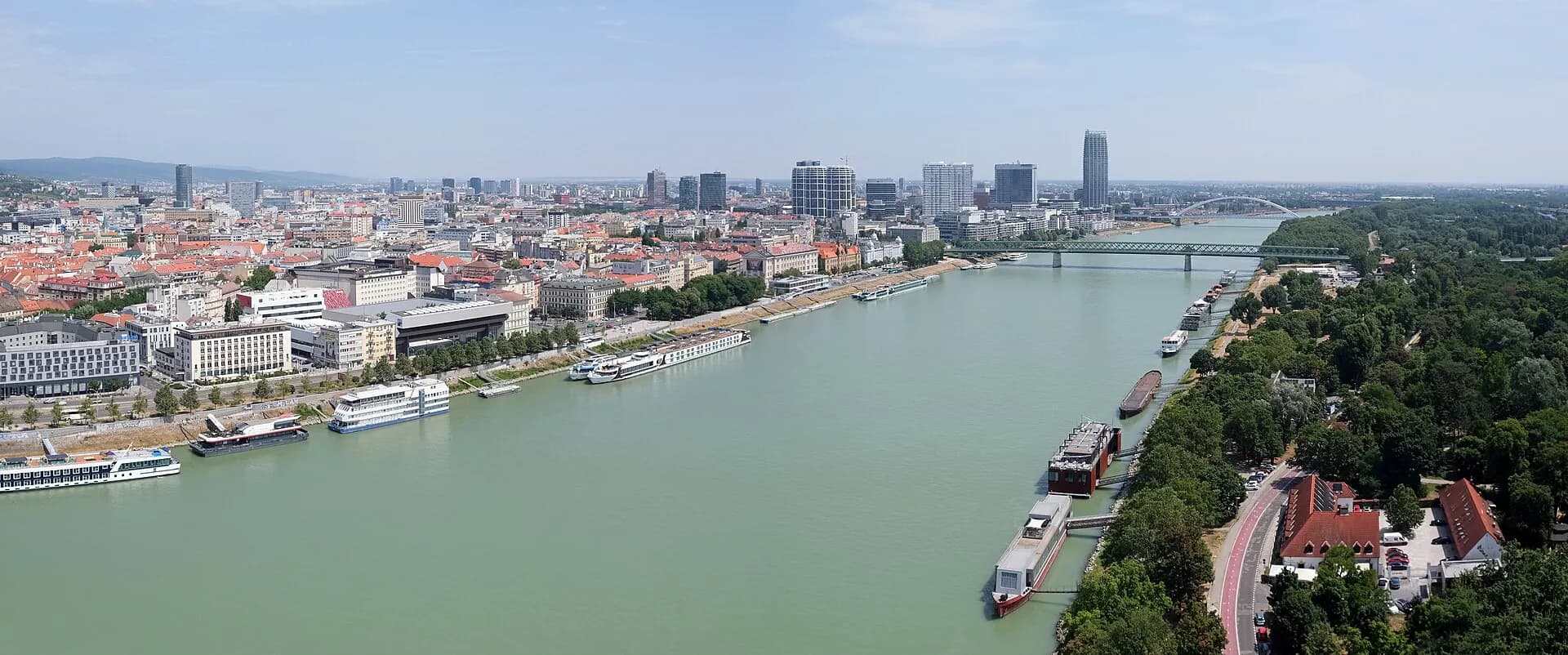
The riverfront has been transformed over the past two decades. From the elegant Slovak National Theatre and the Reduta concert hall, home of the Slovak Philharmonic, a promenade runs east past the old Danube steamer piers to Eurovea, a waterfront development of shops, restaurants, offices and riverside lawns, overlooked by Eurovea Tower, the country's first skyscraper. On warm evenings locals spread out on the grass steps by the water, and in summer there are open-air screenings and pop-up bars. Across the river, the Sad Janka Kráľa, one of the oldest public parks in central Europe, offers shady paths under plane trees.
TipThe riverbank makes a fine walk at dusk, when the castle and the bridge are lit up.
- 6
UFO on the SNP Bridge
Photo: Pudelek (Marcin Szala), CC BY-SA 3.0, via Wikimedia Commons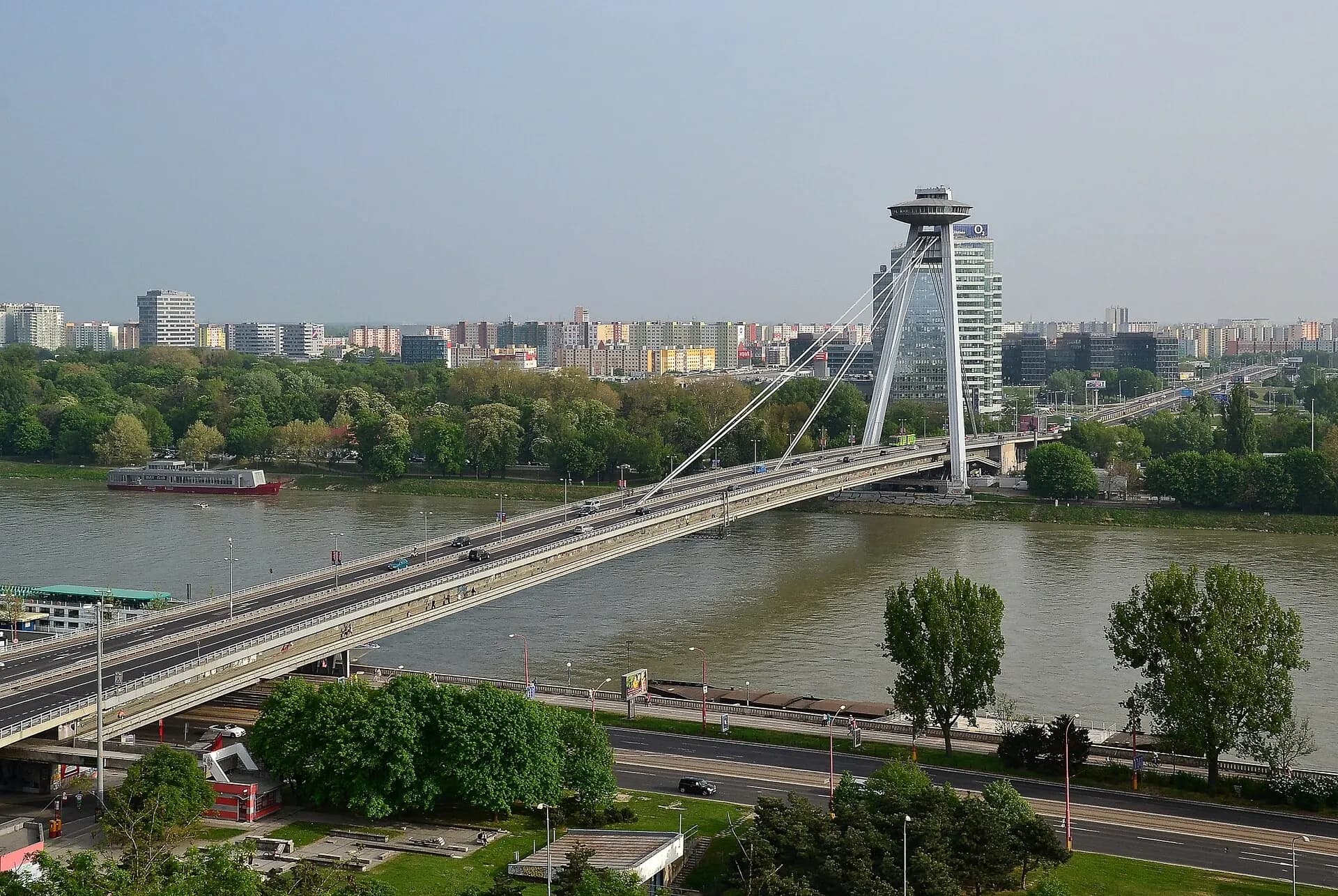
The Bridge of the Slovak National Uprising, opened in 1972, is the boldest piece of socialist-era Bratislava: a single asymmetric pylon leans over the river, with the whole deck hung from cables on one side. Building its approach meant clearing much of the old Jewish quarter and the area below the castle, which still divides opinion. At the top of the pylon, a disc-shaped restaurant and bar universally known as the UFO has an observation deck about 95 metres above the Danube, with views over the Old Town, the castle and the endless towers of Petržalka, and on clear days into Austria and Hungary. A lift runs up inside one of the pylon's legs.
TipThere's an admission fee for the deck, waived if you eat in the restaurant, and the Bratislava CARD gives a discount. Sunset is the most popular, and most crowded, time.
- 7
St Martin's Cathedral
Photo: Ingo Mehling, CC BY-SA 4.0, via Wikimedia Commons
This Gothic cathedral right beside the bridge approach was the coronation church of the Kingdom of Hungary from 1563 to 1830, when Buda was under Ottoman rule and afterwards. Eleven kings and eight queens were crowned here, among them Maria Theresa in 1741. A gilded replica of the Hungarian crown, on a cushion, sits atop the 85-metre spire. Inside, look for the statue of St Martin dividing his cloak by the baroque sculptor Georg Raphael Donner and the chapel of St John the Almsgiver. Brass crowns set into the pavement trace the route the coronation processions took through the streets.
TipThe cathedral closes to sightseers during services. In June, the Coronation Days festival re-enacts a royal coronation with a procession through the Old Town.
- 8
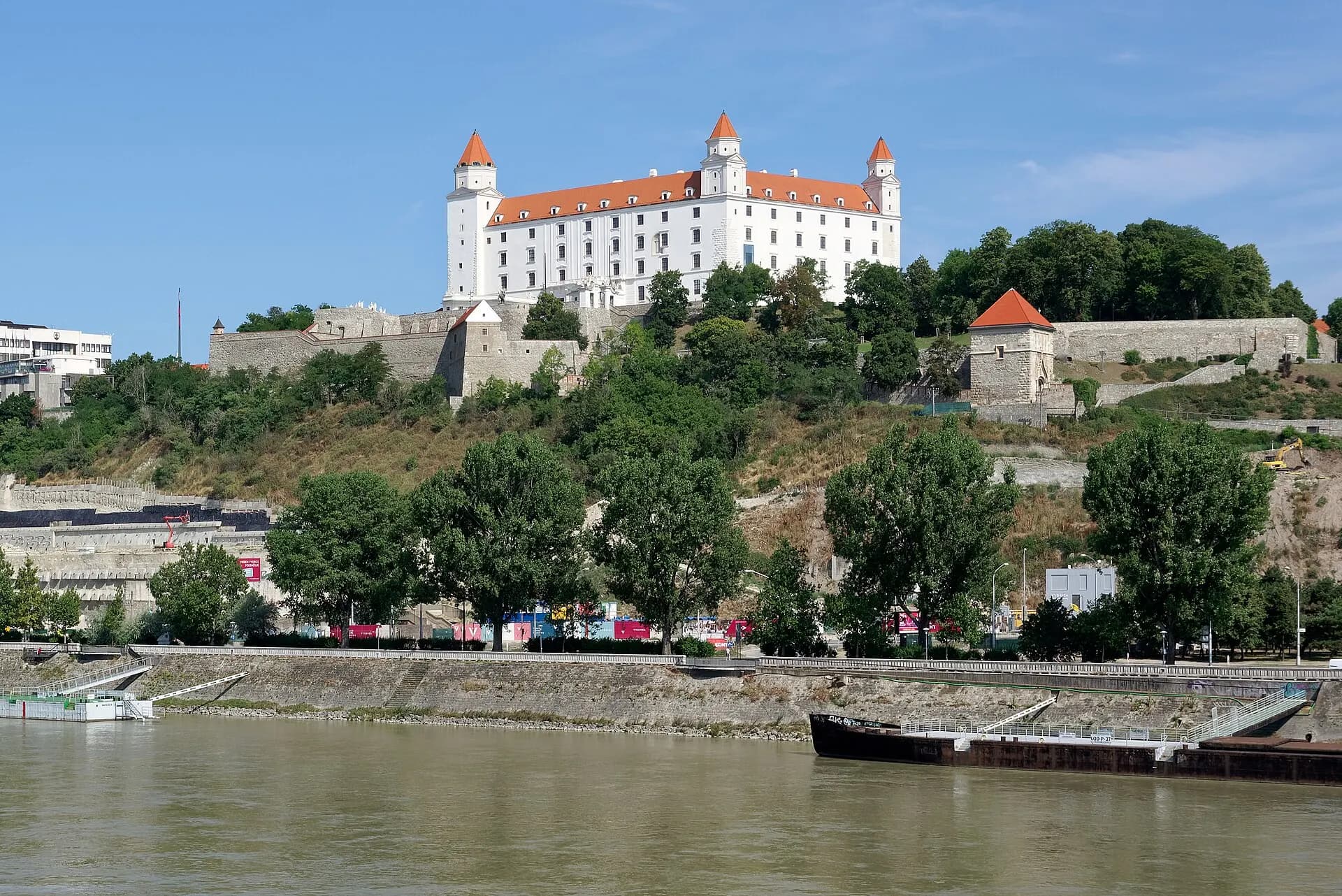
Bratislava Castle
Photo: Ingo Mehling, CC BY-SA 4.0, via Wikimedia Commons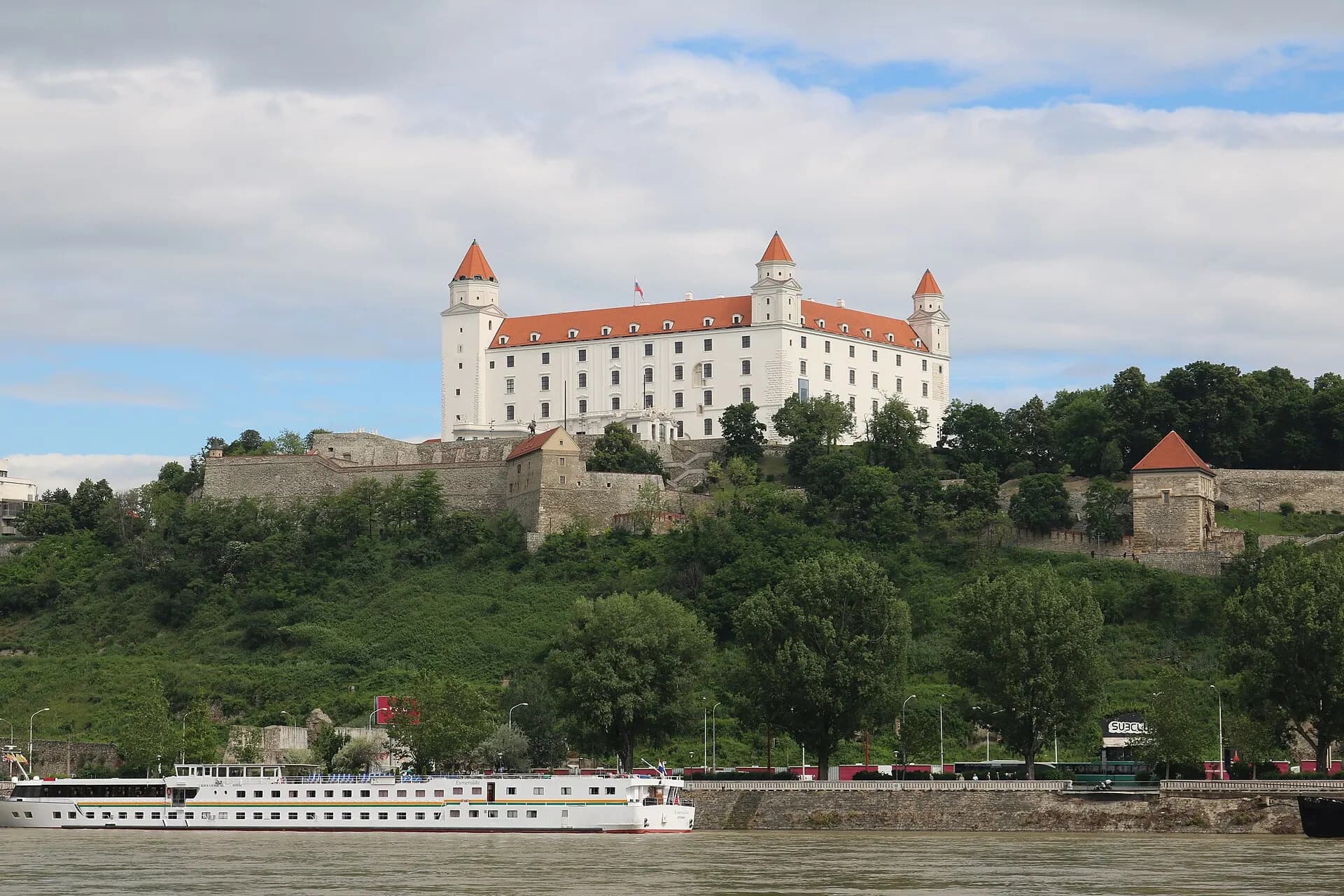
The square white castle with a tower at each corner, sometimes compared to an upturned table, has been the symbol of the city for centuries. A fortress stood on this hill above the Danube from prehistoric times, and the present building was remodelled for the Habsburgs in the eighteenth century, when Maria Theresa used it as a royal residence. It burned in 1811 and stood as a ruin until reconstruction began in the 1950s. Today it houses the Historical Museum of the Slovak National Museum, with exhibits from the Middle Ages to the present, and its terraces and restored baroque garden give the best views over the river and the city.
TipThe castle grounds and gardens are free and open late into the evening; the museum has an entry fee (around €14 in 2026, free with the Bratislava CARD) and is closed on one weekday, so check the hours before going.
- 9
Slavín memorial
Photo: Diego Delso, CC BY-SA 4.0, via Wikimedia Commons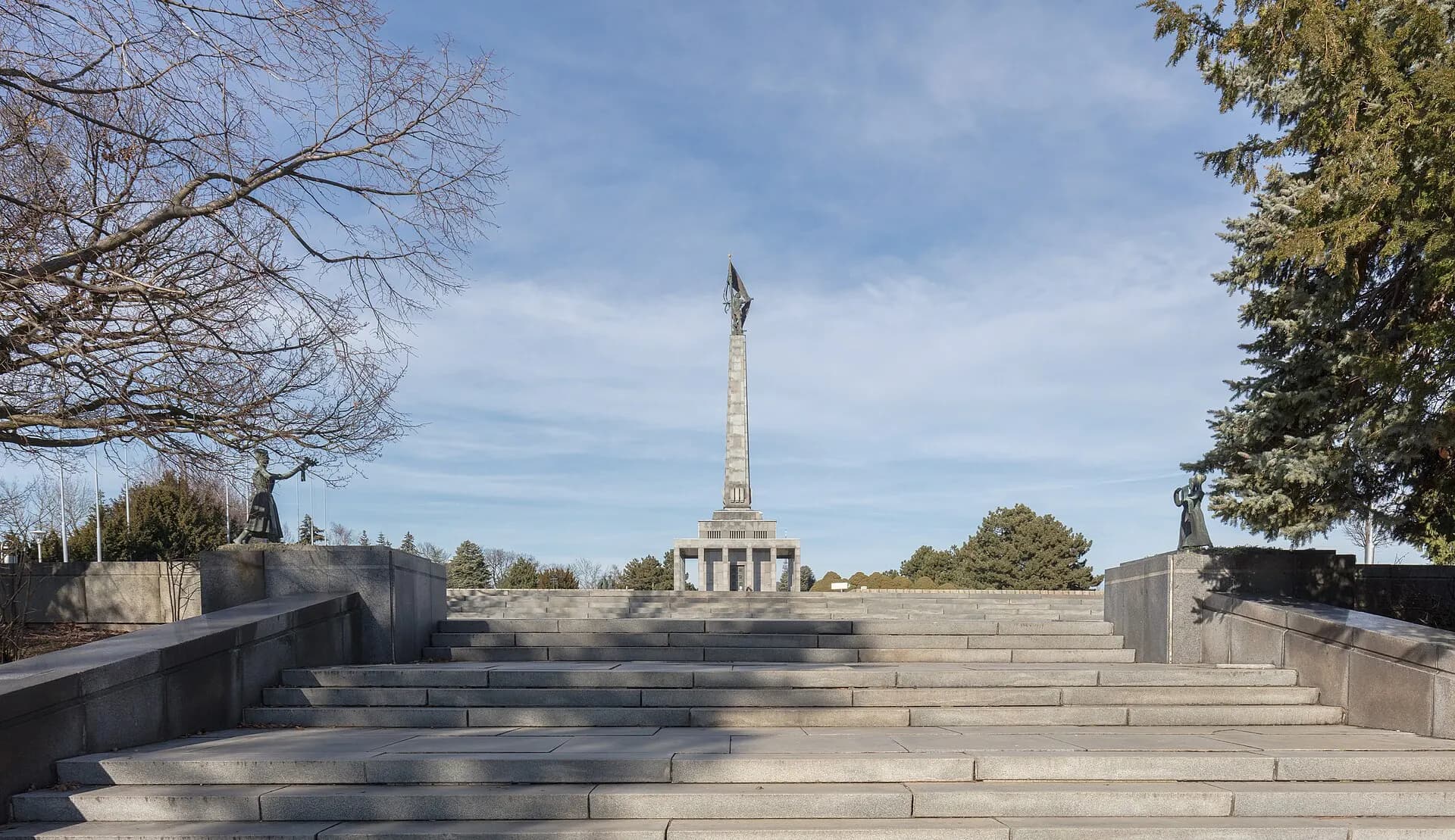
On a hill north of the castle, among some of the city's most expensive villas, stands the monumental memorial and cemetery for the Soviet soldiers who died fighting for the city in 1945. Opened in 1960, it is a sober, Stalinist-style ensemble of terraces, mass graves and a tall obelisk crowned by a soldier with a flag, where some 6,800 soldiers are buried. Whatever you make of its politics, the gardens are peaceful and the panorama over the city, the castle and the river is one of the finest anywhere in Bratislava.
TipIt's a steep but pleasant walk up through the residential streets from the castle; bus is the alternative.
- 10
Kamzík TV tower
Photo: VargaA, CC BY-SA 4.0, via Wikimedia Commons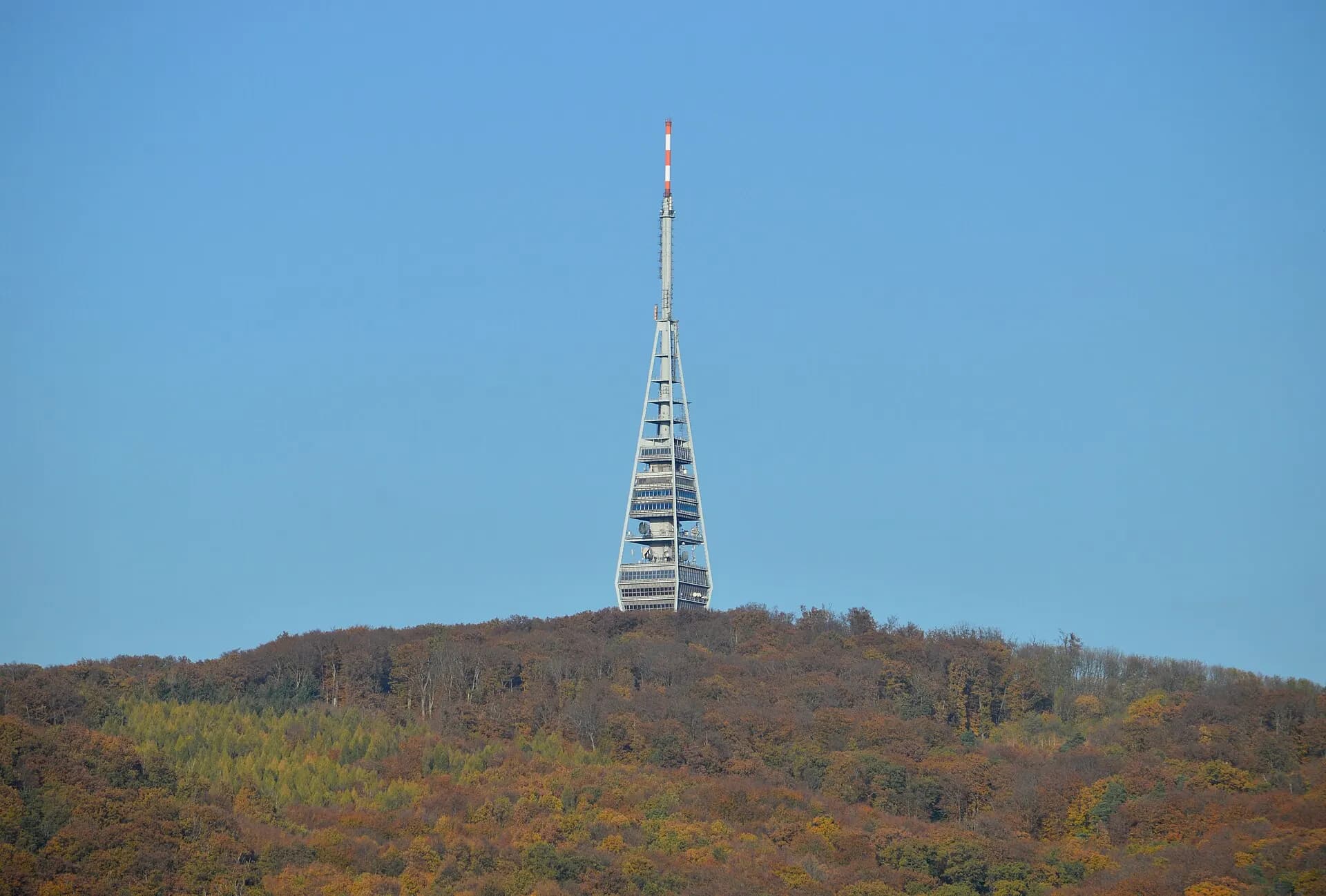
Bratislava's forested hills, the Bratislava Forest Park, begin only a few kilometres from the Old Town, and the needle of the television tower on Kamzík hill, completed in the 1970s, marks them from almost everywhere in the city. A revolving restaurant near the top turns slowly to show the whole city spread out below, and there is a wooden lookout tower nearby too. From Kamzík, marked trails lead through beech woods, and a chairlift drops to Železná studnička, a valley of ponds and picnic spots popular with families, runners and cyclists.
TipCity buses climb to Koliba, near the tower; from there you can walk up to Kamzík in about twenty minutes or hike down through the woods to Železná studnička.
- 11
Devín Castle
Photo: Jakub Hałun, CC BY-SA 4.0, via Wikimedia Commons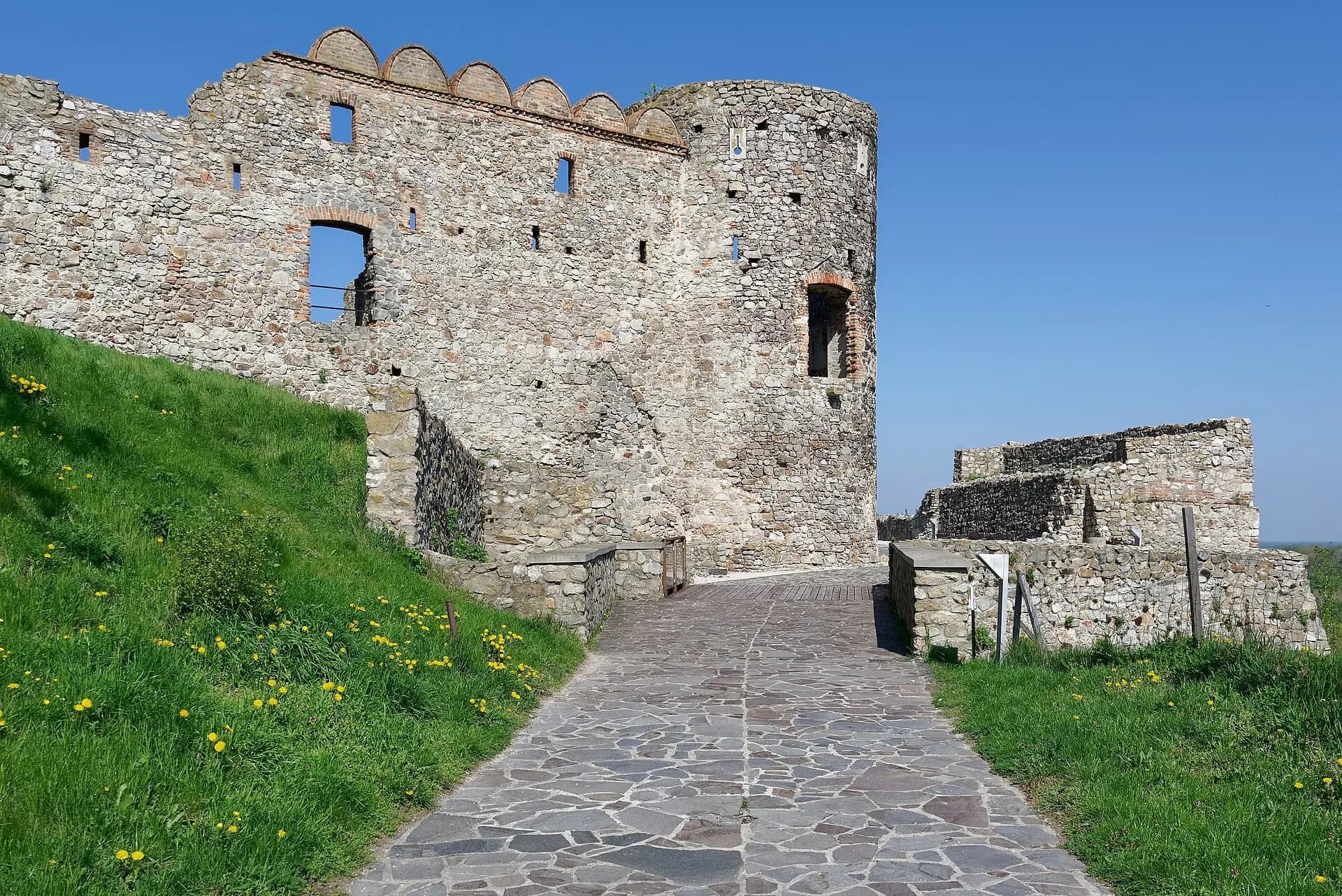
About ten kilometres west of the centre, the ruins of Devín Castle cling to a crag above the point where the Morava river meets the Danube, on the border with Austria. People have lived on this rock since the Stone Age; it was part of the Roman frontier, a stronghold of Great Moravia in the ninth century and later a royal border castle of Hungary, until Napoleon's troops blew it up in 1809. The lonely little watchtower perched on a rock pinnacle, known as the Maiden Tower, is one of the most photographed sights in Slovakia. An exhibition in the cliffside rooms of the upper castle tells its story. Below, a memorial recalls the people shot trying to cross the Iron Curtain here, which ran along the river until 1989.
TipCity buses run from the Most SNP stop under the bridge. In summer, boats sail upstream from the centre. Combine the castle with a walk or bike ride on the Morava cycle route, or a hike up Devínska Kobyla, a hill famous for its rare flowers.
- 12
Danubiana Meulensteen Art Museum
Photo: MoonDaylight, CC BY-SA 4.0, via Wikimedia Commons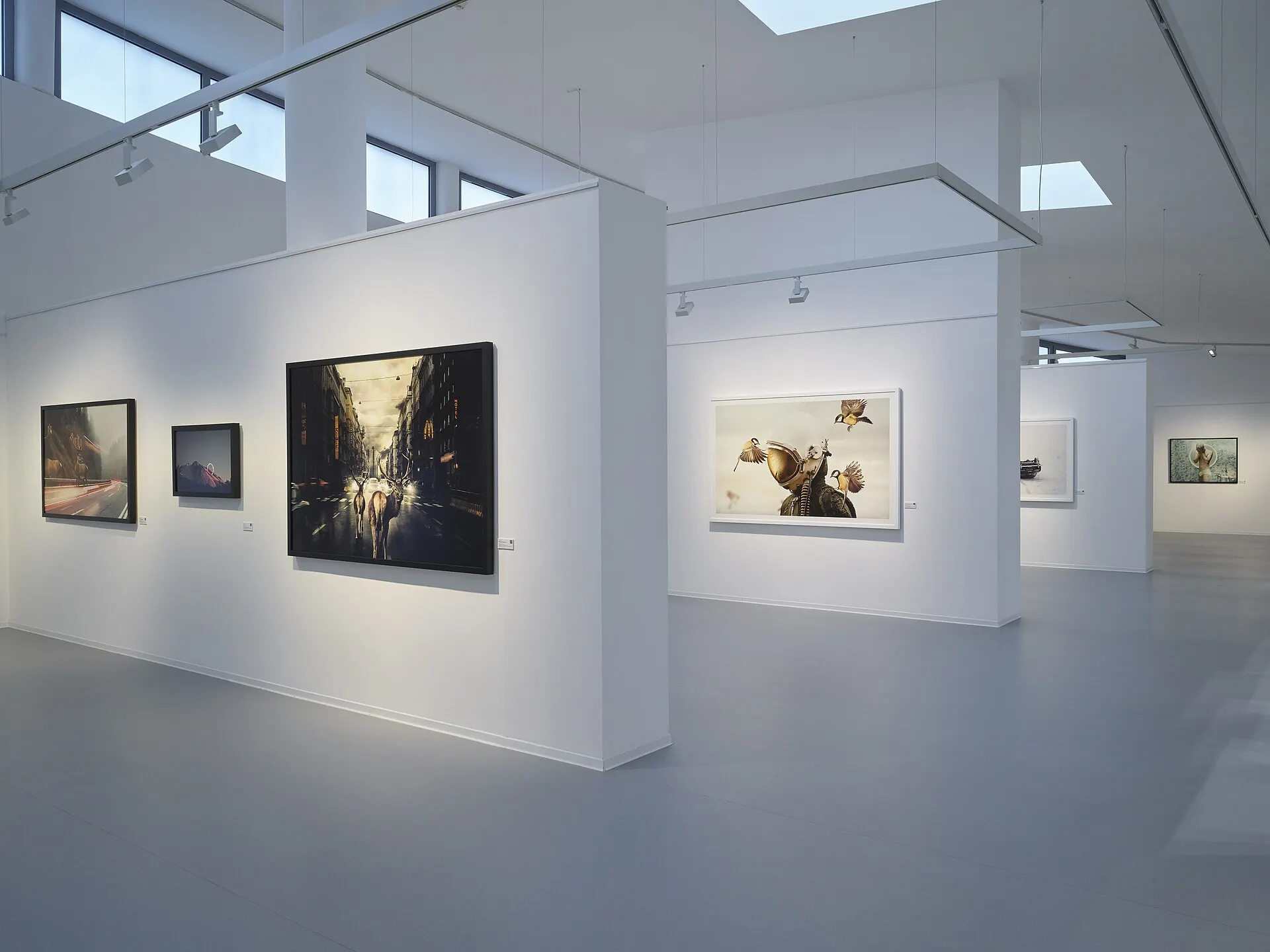
South of the city, at the tip of a narrow peninsula in the Danube near the Čunovo dam, a striking modern building shaped like the hull of a Roman galley holds one of central Europe's more unusual art museums. Founded with the help of the Dutch collector Gerard Meulensteen, it hosts changing exhibitions of modern and contemporary art, from Slovak and central European painters to international names, and the grounds around it form a sculpture park with water on three sides. It's a rewarding half-day out, especially in good weather.
TipThe museum is closed on Mondays. Bus 90 runs from behind the New Slovak National Theatre, or cycle there along the flood dam on the Petržalka side of the river.
- 13
Small Carpathian wine route
Photo: feťour, CC BY 3.0, via Wikimedia Commons
North-east of the city, a chain of old wine towns lines the foot of the Small Carpathians, their vineyards climbing the slopes behind them. Starting from Rača, now part of Bratislava, the route passes Svätý Jur, a sleepy town of old wine houses, then Pezinok, with its castle, town hall and small wine museum, and Modra, known for its blue-and-white majolica pottery and as the place where the nineteenth-century national leader Ľudovít Štúr spent his last years. The local grapes include Grüner Veltliner, Welschriesling, Riesling and Frankovka, and family wineries open their cellars for tastings throughout the year.
TipThe highlight of the year is the Open Cellar Day in November, when you buy a wristband and glass and wander from cellar to cellar; the 2026 edition is on 20 and 21 November. Regional trains and buses link Bratislava with Svätý Jur, Pezinok and Modra, so there's no need to drive.
- 14
Červený Kameň Castle
Photo: Pudelek (Marcin Szala), CC BY-SA 3.0, via Wikimedia Commons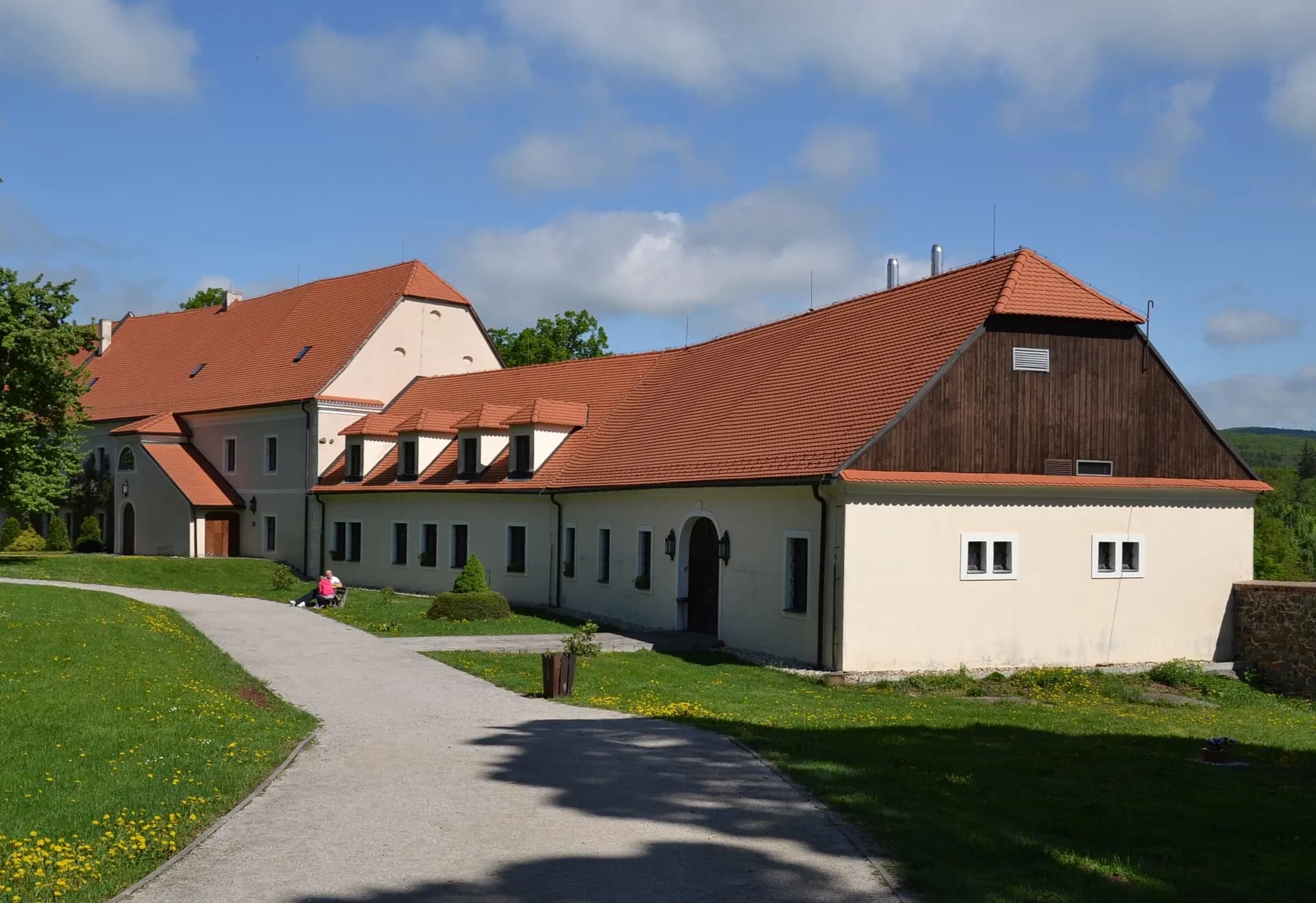
Above the village of Častá, in the woods of the Small Carpathians, the Red Stone Castle is one of the best preserved in Slovakia. It was built as a fortress in the thirteenth century, rebuilt by the Fugger banking family in the sixteenth century, and turned into a grand residence by the Pálffy family, who furnished it with fine interiors and a sala terrena decorated with shell and stucco work. Its vast cellars, designed to store trade goods, are among the largest in central Europe. Today it's a branch of the Slovak National Museum, with guided tours of the furnished rooms, the cellars and the fortifications, and falconry displays in season.
TipThe castle is open all year but has shorter hours and Monday closures in winter; the main season runs from May to September. It pairs well with an afternoon in the wine town of Modra, a short drive away.
When to go
Late spring and early autumn are the best times. From May to June the parks are green, the riverside café terraces are open and the Coronation Days and summer cultural programme get going; September and October bring the grape harvest, the vinobranie wine festivals in Pezinok, Modra and Rača, and mild days for walking up to Slavín or Devín. July and August can be hot, often over 30°C, and the Old Town fills with day-trippers from Vienna and river-cruise passengers, though the evenings by the water are lovely.
Winter is cold and often grey, with the occasional snowfall, but late November and December are a fine time to come for the Christmas markets on the Main Square and Františkánske námestie, and for the young St Martin's wine released in mid-November. January and February are the quietest months, when some outlying sights keep shorter hours.
Getting around
Bratislava's Old Town is small, mostly pedestrianised and easily walked in a few minutes from end to end. For anything further, the city's trams, buses and trolleybuses are cheap and frequent. They belong to the regional integrated transport system, IDS BK, which also covers regional trains and buses to towns like Pezinok and Modra. Tickets are time-based; buy them before boarding from machines at stops, through the official app, and validate paper tickets as soon as you get on. Inspectors are common. The Bratislava CARD includes unlimited public transport along with free entry to many sights.
The main railway station, Hlavná stanica, is a short tram or bus ride north of the Old Town. Frequent trains reach Vienna in about an hour, and there are regular direct services to Budapest in around two and a half hours and to Prague in about four. Buses also link Bratislava with Vienna and Vienna airport, which many visitors use as their gateway, roughly an hour away. Bratislava's own airport, with mostly low-cost and holiday flights, is connected to the centre and the main station by city bus 61.
From spring to autumn the Twin City Liner catamaran sails along the Danube between Vienna and Bratislava, docking right by the Old Town; it's a scenic, if pricier, alternative to the train. Bikes are useful for Devín, Danubiana and the riverside paths, and there's a city bike-share scheme.
Local tips
- The euro is the currency. Cards are accepted almost everywhere, but carry a little cash for small cellars and village shops on the wine route.
- Many restaurants offer a cheap set lunch, the denné menu, on weekdays: soup and a main course for a fraction of evening prices.
- Lunch is often eaten early, from about 11.30, and some smaller kitchens close earlier in the evening than in Western Europe.
- Slovak is the language; younger people usually speak good English, and German is widely understood. A "dobrý deň" (good day) and "ďakujem" (thank you) go a long way.
- Tipping around 10 per cent is normal in restaurants if service was good.
- Check opening days before setting out: many museums close on Mondays, and Bratislava Castle's museum and Červený Kameň keep their own schedules.
- Watch for cyclists and e-scooters on the riverside paths, and beware of tourist-trap pricing on menus without prices around the Main Square.
Eat and drink
Slovak cooking is hearty mountain food. The national dish is bryndzové halušky, small potato dumplings tossed with soft, tangy sheep's cheese and topped with crisp bacon; it is often paired with a glass of žinčica, a sour drink made from sheep's whey, for the brave. Kapustnica, a smoked sauerkraut soup with sausage and mushrooms, is the classic Christmas dish but turns up all winter. Look for lokše, thin potato pancakes filled with goose fat, liver pâté or poppy seeds, and for the Bratislava rožok, a crescent-shaped pastry filled with walnuts or poppy seeds that has been baked here since the days of Pressburg.
The country's wine culture is centred on the Small Carpathians, right on the city's doorstep, and many Old Town wine bars pour local whites like Grüner Veltliner and Welschriesling by the glass. Slovak beer is cheap and good, from big national brands to a growing number of microbreweries, and the herbal liqueur Demänovka and fruit brandies such as slivovica, plum brandy, are traditional digestifs. For a hearty meal with a view, the koliba-style restaurants on Kamzík serve grilled meats in wooden mountain-hut surroundings.
Where to stay
The Old Town is the obvious choice for a short visit, putting the castle, cathedral and restaurants on your doorstep, though rooms facing busy bar streets can be noisy at weekends. The streets just east of it, around the Blue Church and the Danube embankment towards Eurovea, are quieter and have a good mix of modern hotels and apartments. Near the main railway station is practical for onward trains to Vienna, Budapest or Prague. Wine lovers might consider a night or two in Pezinok, Svätý Jur or Modra, where small guesthouses sit among the vineyards. Prices are generally lower than in Vienna, and many travellers base themselves in Bratislava for day trips across the border.
Further afield: the High Tatras and Spiš Castle
With more time, it's worth heading east across the country. The High Tatras, a sharp little range of granite peaks, glacial lakes and pine forest on the Polish border, are the highest mountains in the Carpathians and the heart of Slovakia's oldest national park. Resorts such as Štrbské Pleso, Starý Smokovec and Tatranská Lomnica are linked by an electric mountain railway and make bases for hiking in summer and skiing in winter; note that the highest trails are closed each year from November to mid-June to protect the mountains. Direct trains from Bratislava to Poprad, the gateway town, take around four hours.
An hour or so further east, the immense ruin of Spiš Castle sprawls across a limestone hill above Spišské Podhradie. Covering about four hectares, it is one of the largest castle complexes in central Europe, and together with the nearby church town of Spišská Kapitula and the medieval town of Levoča it forms part of a UNESCO World Heritage Site. Combine the two over three or four days, or continue to the wooden churches and towns of eastern Slovakia, or north to Kraków in Poland.
A short history
The Danube crossing here has drawn settlers since prehistoric times: the Celts minted coins on the castle hill, the Romans guarded their frontier from Devín and Gerulata, and the ninth-century principality of Great Moravia held the castle crags. From the eleventh century the town belonged to the Kingdom of Hungary, and German-speaking merchants made it a prosperous trading town. After the Ottomans took Buda in 1541, Pressburg, as it was then known in German, became Hungary's capital and coronation city, hosting the Hungarian Diet until 1848.
In 1919 the city, home to Germans, Hungarians and Slovaks, became part of the new Czechoslovakia and took the name Bratislava. The Second World War brought a Nazi-aligned Slovak state and the deportation of the city's Jewish community, and the communist decades after 1948 brought both the SNP Bridge and the great housing estates. Bratislava was a centre of the Velvet Revolution in 1989, and in 1993 it became the capital of an independent Slovakia, which joined the European Union in 2004 and adopted the euro in 2009.
Responsible travel
Bratislava's Old Town is small and feels the pressure of day-trippers and river-cruise groups at peak times, so try staying overnight, when the streets quieten and you put more money into local businesses. Eat at family-run restaurants and buy wine directly from Small Carpathian growers rather than at souvenir shops. At Devín and Devínska Kobyla, stick to the marked paths: the meadows are protected nature reserves with rare orchids and steppe plants. Use the excellent public transport and regional trains rather than a car, and remember that Slavín is a cemetery as well as a viewpoint, so behave with respect.