Damascus
One of the oldest continuously inhabited cities on earth, whose mosques, souqs and Roman streets anchor a country of extraordinary heritage that governments currently advise against visiting.
- Best time to go
- Spring (April to May) and autumn (late September to early November) are mild; summers are very hot and winters cold. Travel only if official advice changes.
- Local time
- –
- Currency
- Syrian Pound (SYP)
- Reading time
- 16 min
- Language
- Arabic

Current advice, checked 27 October 2026: do not travel. The UK Foreign, Commonwealth & Development Office "advises against all travel to Syria due to unpredictable security conditions and the threat of terrorist attacks", and says consular support is not available from the British government from within Syria. The US Department of State rates Syria at Level 4, "Do Not Travel", its highest level, citing terrorism, unrest, kidnapping, hostage taking, crime and armed conflict; the advisory was last reissued on 23 October 2026, and the US government says it cannot provide routine or emergency services to its citizens in the country. Travel insurance is very likely to be invalid if you go against this advice. This guide is written as an introduction to Syria's heritage, for readers who want to understand it now and for the day when official advice allows a visit. It is not an encouragement to travel.
Damascus has a strong claim to be one of the oldest continuously inhabited cities in the world. Aramaeans, Romans, Byzantines, the Umayyad caliphs, Ayyubids, Mamluks and Ottomans all left buildings inside the walled Old City, where a Roman street plan still shapes the lanes and a great eighth-century mosque stands on the site of a Roman temple and a Christian basilica. The Old City has been on UNESCO's World Heritage List since 1979, and, like all six of Syria's World Heritage properties, it was placed on the List of World Heritage in Danger in 2013 because of the war that began in 2011.
The country changed sharply in December 2024. On 8 December, after a rapid offensive led by the armed group Hayat Tahrir al-Sham, the government of Bashar al-Assad fell and new authorities took over in Damascus; Ahmed al-Sharaa was named transitional president in early 2025. Some international sanctions have since been lifted while others remain, and the security picture remains uneven: there have been outbreaks of violence in several regions, the FCDO notes that local armed groups control some areas outside government control, particularly Suwayda province in the south, and an Islamic State-linked suicide bombing at the Mar Elias church in Damascus's Dweila district killed at least 20 worshippers in June 2025. Conditions can change quickly, so always read the latest official advice rather than any guidebook.
The places below are ordered as a walk through Damascus from the National Museum to the eastern gate of the Old City, followed by the country's major heritage sites in a loop: south to Bosra, north to Maaloula, east into the desert to Palmyra, then up through the Orontes valley to Krak des Chevaliers, Hama, Apamea and Aleppo. Several of these sites have suffered serious damage, and that is described plainly where it is documented.
The top 15 in Damascus
- 1
National Museum of Damascus
Photo: Schumeru, CC BY-SA 3.0, via Wikimedia Commons
Founded in 1919, the National Museum is Syria's oldest cultural institution, and its collection runs from prehistoric tools to Islamic manuscripts. Visitors enter through the reconstructed gateway of Qasr al-Hayr al-Gharbi, an Umayyad desert palace of 727 that was moved stone by stone from the steppe west of Palmyra. Inside are clay tablets from Ugarit, including one inscribed with an early alphabet of thirty signs, and the reconstructed synagogue of Dura-Europos, a mid-third-century room whose walls are covered in painted biblical scenes, one of the most remarkable survivals of ancient Jewish art anywhere.
The museum closed in 2012, when more than 300,000 objects were hidden for safekeeping, and reopened most of its wings in 2018. It closed again briefly after the change of government in December 2024 and reopened in January 2025. In November 2025 six small Roman-era marble statues were stolen from the classical department, prompting an investigation and a temporary closure; check current opening before planning anything around it.
- 2
Sulaymaniyya Takiyya
Photo: Dosseman, CC BY-SA 4.0, via Wikimedia Commons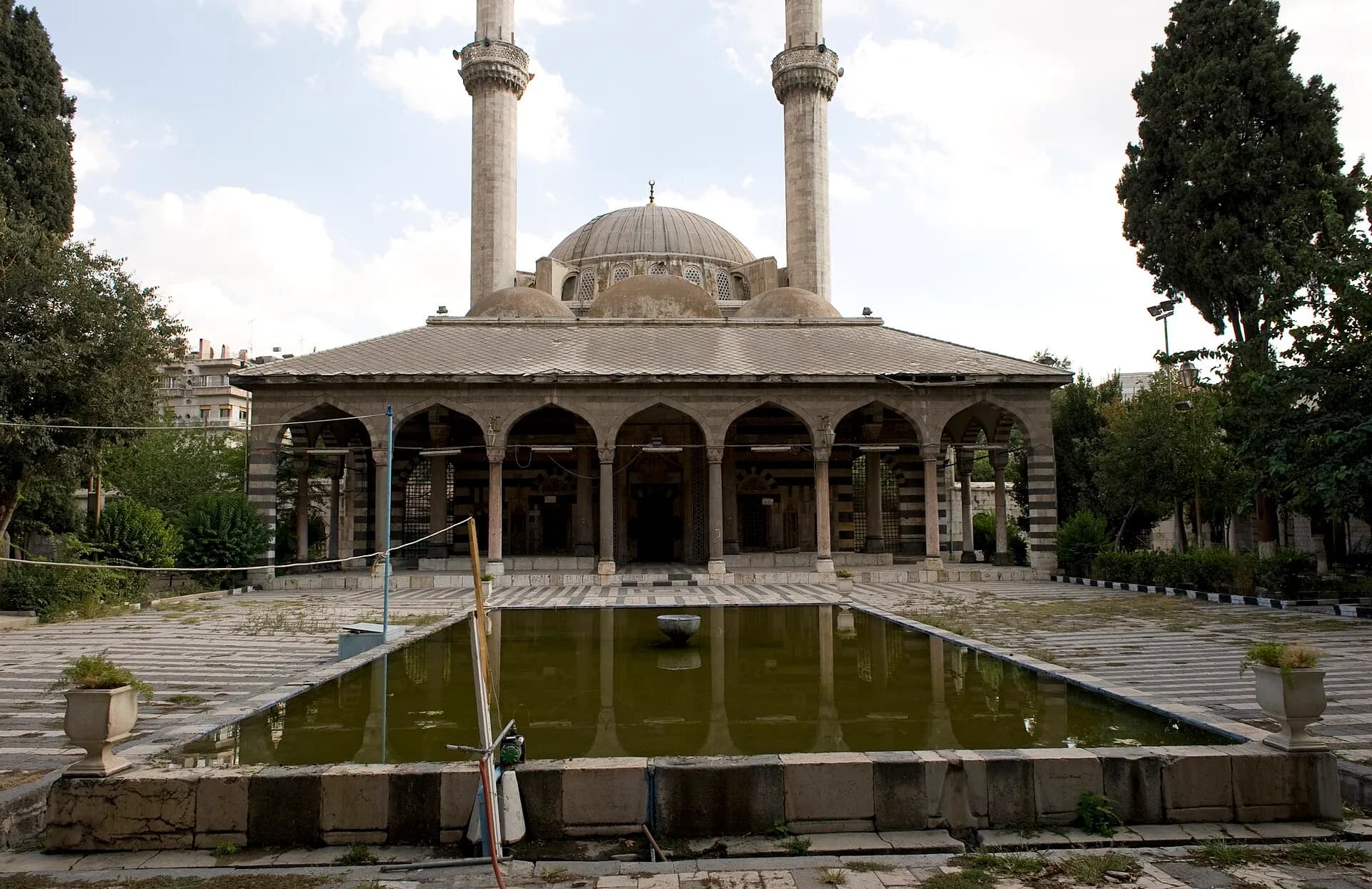
Next door to the museum, this Ottoman complex was commissioned by Sultan Suleiman the Magnificent in the 1550s and designed by his chief architect, Mimar Sinan, whose work also fills Istanbul. Its mosque, with two slender pencil minarets and striped black and white stone, faces a courtyard with a long pool, once a hostel for pilgrims setting out on the long caravan route to Mecca. The adjoining madrasa, around a smaller garden court, has for decades housed craft workshops selling inlaid wood, brass and textiles.
- 3
Souq al-Hamidiyah
Photo: Bernard Gagnon, CC BY-SA 3.0, via Wikimedia Commons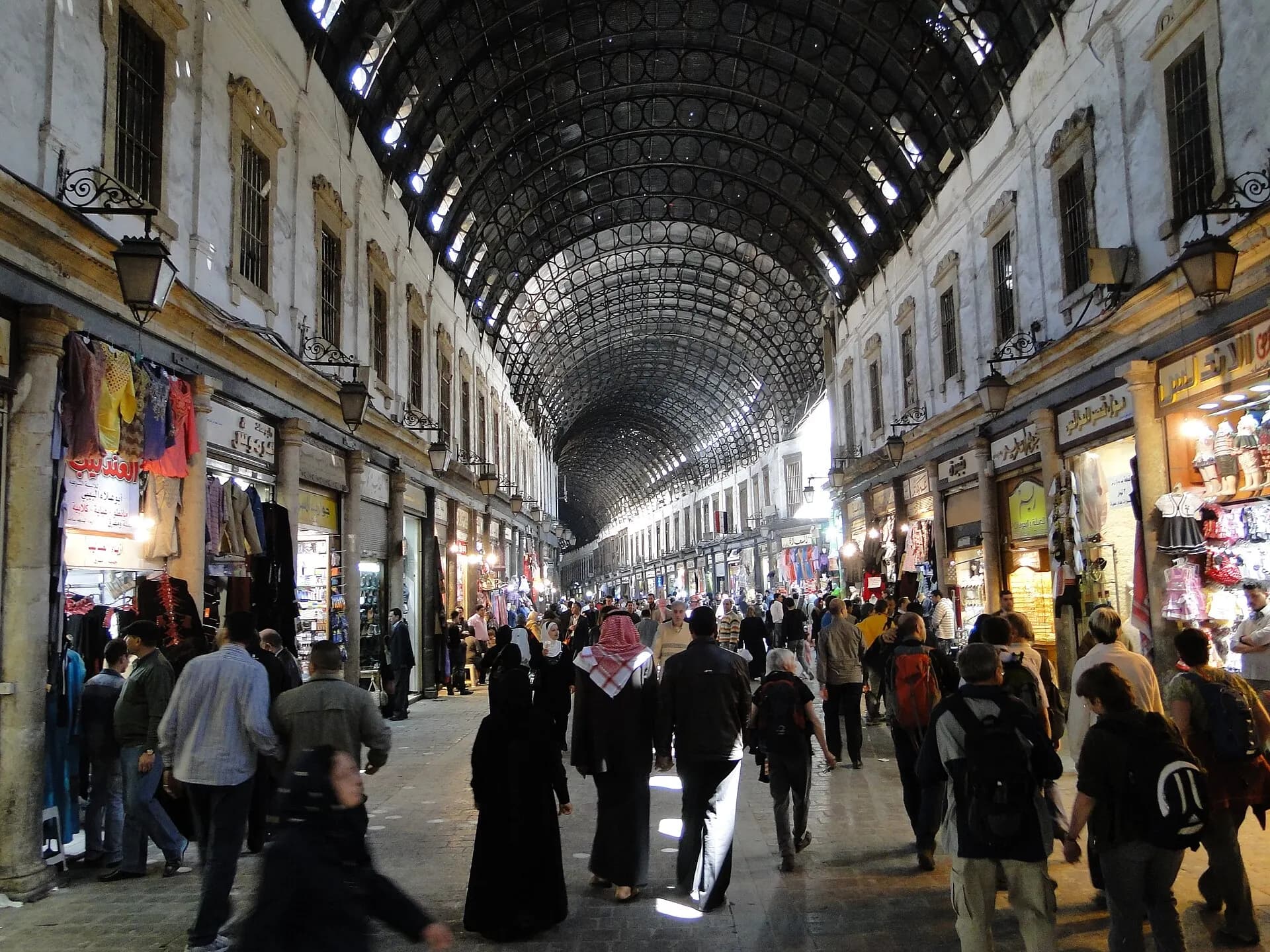
The Old City's main covered market runs east from the citadel for about half a kilometre under a high, arched iron roof, pierced by countless small holes that let shafts of light fall onto the crowd; many of them are said to date from gunfire and shrapnel during fighting in the 1920s. The souq takes its name from the Ottoman sultan Abdul Hamid II, under whom it was rebuilt in the late nineteenth century, and is lined with shops selling clothes, fabrics, perfume and sweets. At its eastern end the roof stops abruptly at the columns and pediment of the Roman Temple of Jupiter's western gateway, standing in the open air in front of the mosque.
TipBakdash, an ice-cream parlour in the souq known for its mastic-scented booza pounded with pistachios, has been a Damascus institution for more than a century.
- 4
Umayyad Mosque
Photo: Vyacheslav Argenberg, CC BY 4.0, via Wikimedia Commons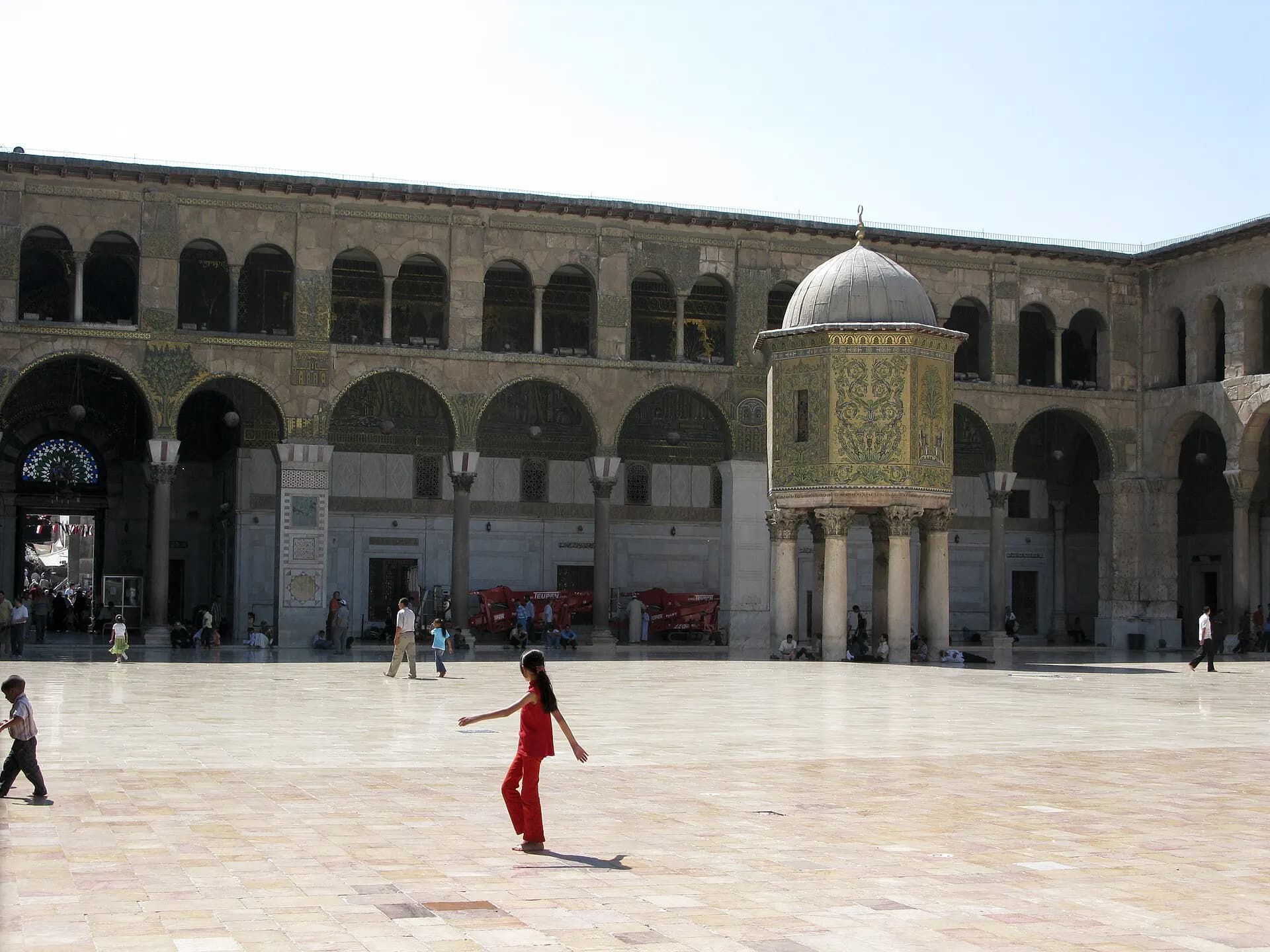
Completed in the early eighth century under the caliph al-Walid I, the Great Mosque of Damascus is one of the oldest and most important mosques in the world, and its plan influenced mosque architecture for centuries. The site has been sacred for perhaps three thousand years: an Aramaean temple of the storm god Hadad, then the Roman Temple of Jupiter, then a Christian basilica dedicated to John the Baptist. A shrine said to hold the head of John the Baptist (revered as the prophet Yahya in Islam) still stands inside the prayer hall, and Christians as well as Muslims come to pray there.
The vast marble courtyard is the heart of the city. Its arcades and the treasury dome raised on columns still carry large areas of the original gold and green glass mosaics, showing rivers, trees and fantastic palaces, the work of craftsmen from the Byzantine tradition. Three minarets rise at the corners, including the Minaret of Jesus, where local tradition holds that Christ will descend at the end of time.
TipThe mosque has historically admitted non-Muslim visitors outside prayer times; women have been asked to wear a hooded robe provided at the entrance, and everyone removes their shoes.
- 5
Mausoleum of Saladin
Photo: Bernard Gagnon, CC BY-SA 3.0, via Wikimedia Commons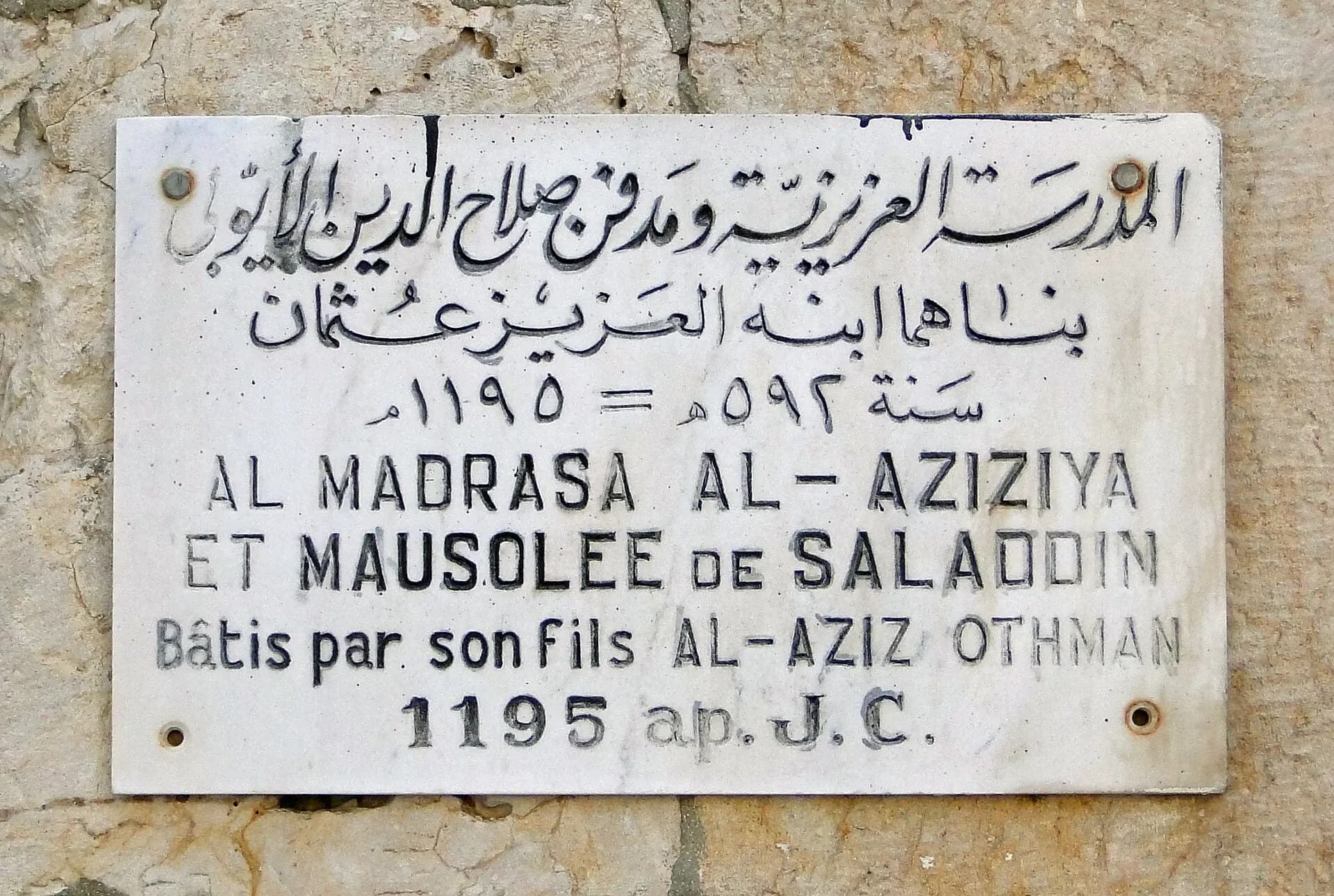
In a small garden against the north wall of the Umayyad Mosque, a modest domed building holds the tomb of Salah ad-Din, the Kurdish-born sultan who recaptured Jerusalem from the crusaders in 1187 and died in Damascus in 1193. Inside are two cenotaphs: the original carved walnut one, and a white marble tomb donated in 1898 by the German emperor Wilhelm II during his visit to the city. The contrast between the austere building and the scale of the man's reputation, in both the Islamic world and medieval European legend, is striking.
- 6
Azm Palace
Built in 1749–50 for As'ad Pasha al-Azm, the Ottoman governor of Damascus, this palace is the finest surviving example of the city's grand courtyard houses. Bands of black basalt, white limestone and golden sandstone stripe the walls around a garden of citrus trees, fountains and pools, and the reception rooms have painted and gilded wooden ceilings. The palace houses a museum of popular arts and traditions, with tableaux of Damascene domestic life, costume and crafts, and it gives a vivid sense of how the city's wealthy families once lived behind blank street walls.
- 7
Straight Street
Photo: Bryn Pitzgauer, CC BY 2.0, via Wikimedia Commons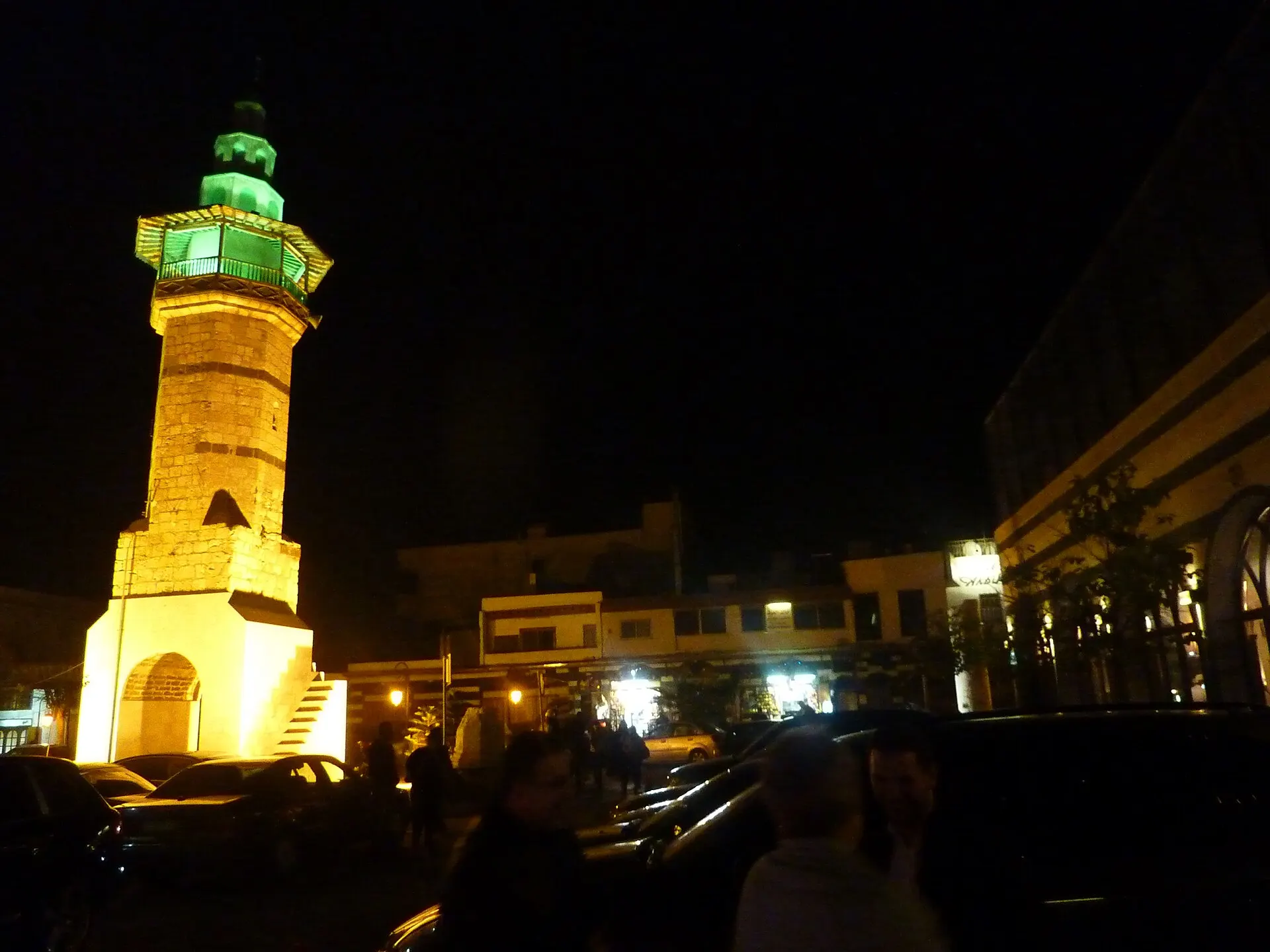
The Street Called Straight of the Acts of the Apostles, where Saul of Tarsus was taken after his blinding vision on the road to Damascus, follows the line of the Roman decumanus maximus, which ran the full width of the walled city from west to east. Today it is narrower and busier than its Roman ancestor, lined with spice shops, woodworkers and khans, and its eastern half passes through the old Christian quarter, with churches of several denominations close by. Near its midpoint stands a reconstructed Roman arch, a remnant of the colonnaded avenue.
- 8
Chapel of Ananias
Photo: Bernard Gagnon, CC BY-SA 3.0, via Wikimedia Commons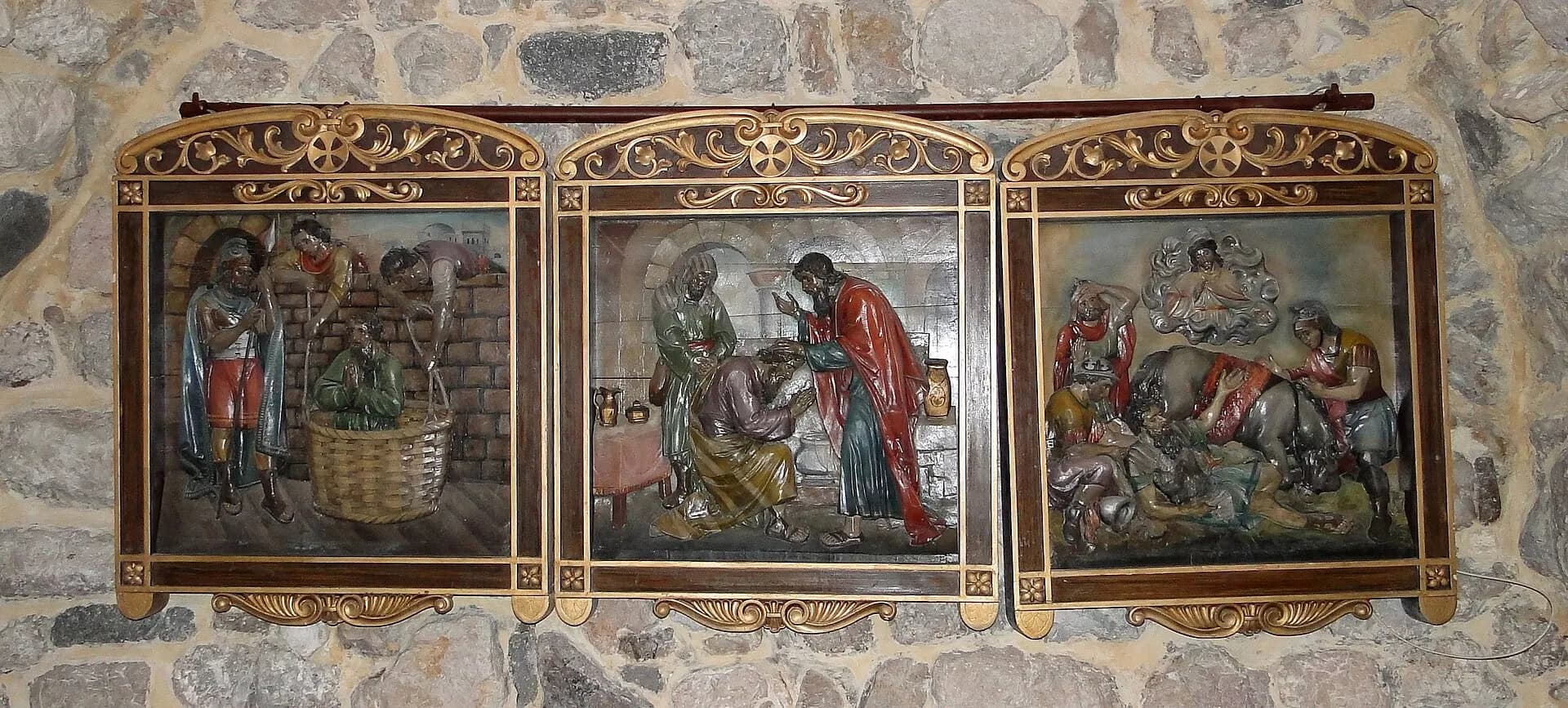
Down a quiet lane near Bab Sharqi, the eastern gate of the Old City, steps lead down into a small stone crypt venerated as the house of Ananias, the disciple who, according to Acts, restored Saul's sight and baptised him, after which Saul became the apostle Paul. The underground chapel, simple and lit by candles, sits at the level of the ancient city, several metres below today's street. Bab Sharqi itself is the only one of the Roman gates of Damascus to survive largely in its original form, and the lanes of Bab Touma nearby are among the most atmospheric in the Old City.
- 9
Bosra
Photo: Vyacheslav Argenberg, CC BY 4.0, via Wikimedia Commons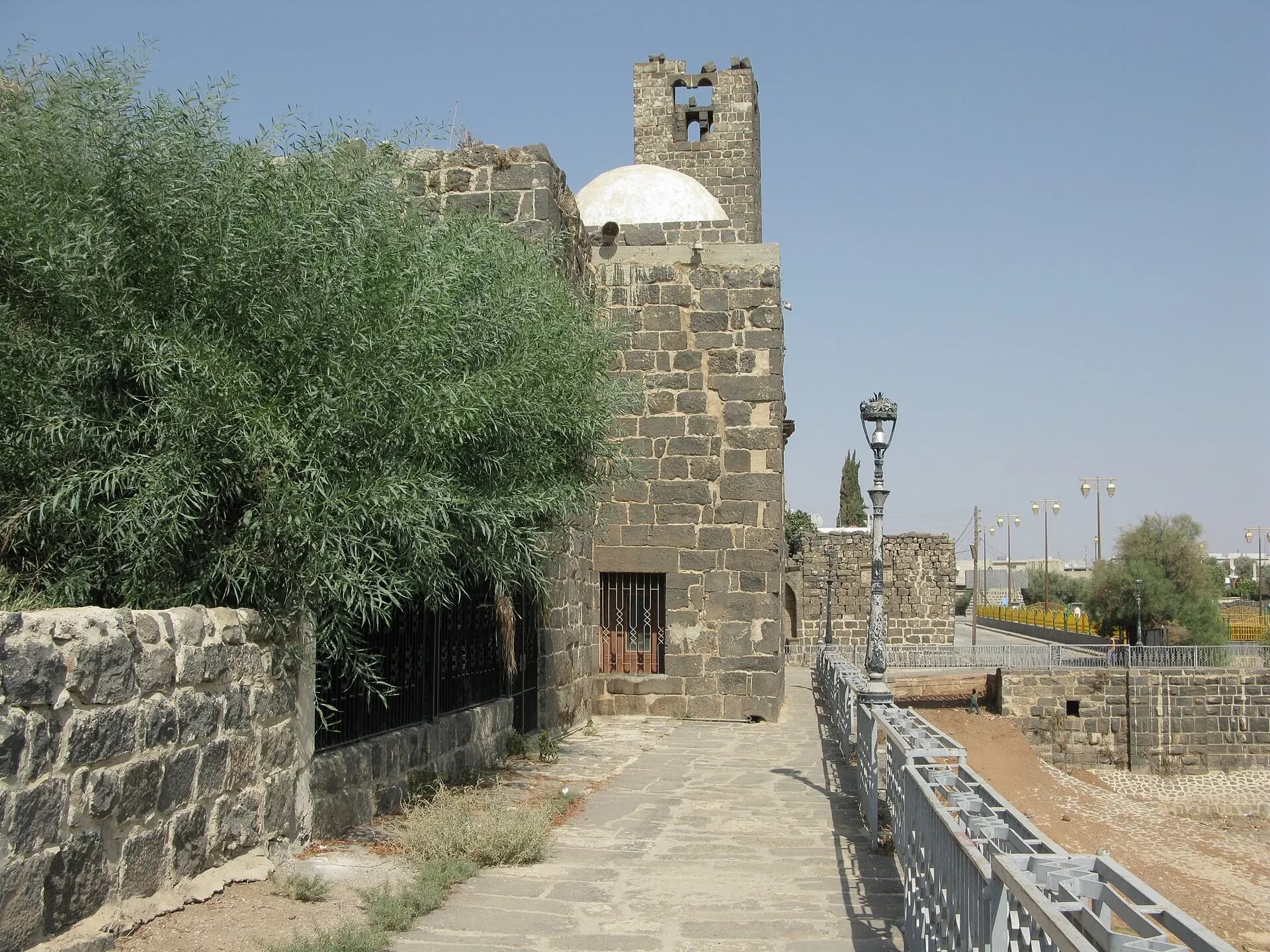
Around 140 kilometres south of Damascus, near the Jordanian border, Bosra was the capital of the Roman province of Arabia, and its black basalt Roman theatre, built in the second century AD, is one of the best preserved anywhere, with seating for around 17,000 people. It survived because the Ayyubids wrapped it inside a massive fortress in the twelfth and thirteenth centuries, turning the theatre itself into the citadel's core. The town also has Roman baths, a colonnaded street, early Christian churches and the Mabrak mosque, linked by tradition to the Prophet Muhammad's camel.
Bosra lies in Daraa province, where fighting was intense during the war; UNESCO has reported damage from military activity at the site, and the wider south remains volatile.
- 10
Maaloula
Photo: High Contrast, CC BY 3.0 de, via Wikimedia Commons
Built into a cleft in the cliffs of the Qalamoun mountains about 55 kilometres north-east of Damascus, Maaloula is one of the very few places where a form of Western Aramaic, a language related to the one spoken by Jesus, is still in daily use. Its pastel houses climb the rock face around the convent of Saint Thecla, built around the cave and spring associated with the early Christian saint, and the monastery of Saints Sergius and Bacchus, one of the oldest surviving churches in Syria.
Maaloula was seized by armed opposition groups in 2013, and a group of nuns from the Saint Thecla convent was held captive for several months before being released in 2014. Churches, monasteries and icons were damaged and looted during the fighting, and many residents left; parts of the village have since been restored.
- 11
Palmyra
Photo: Bernard Gagnon, CC BY-SA 3.0, via Wikimedia Commons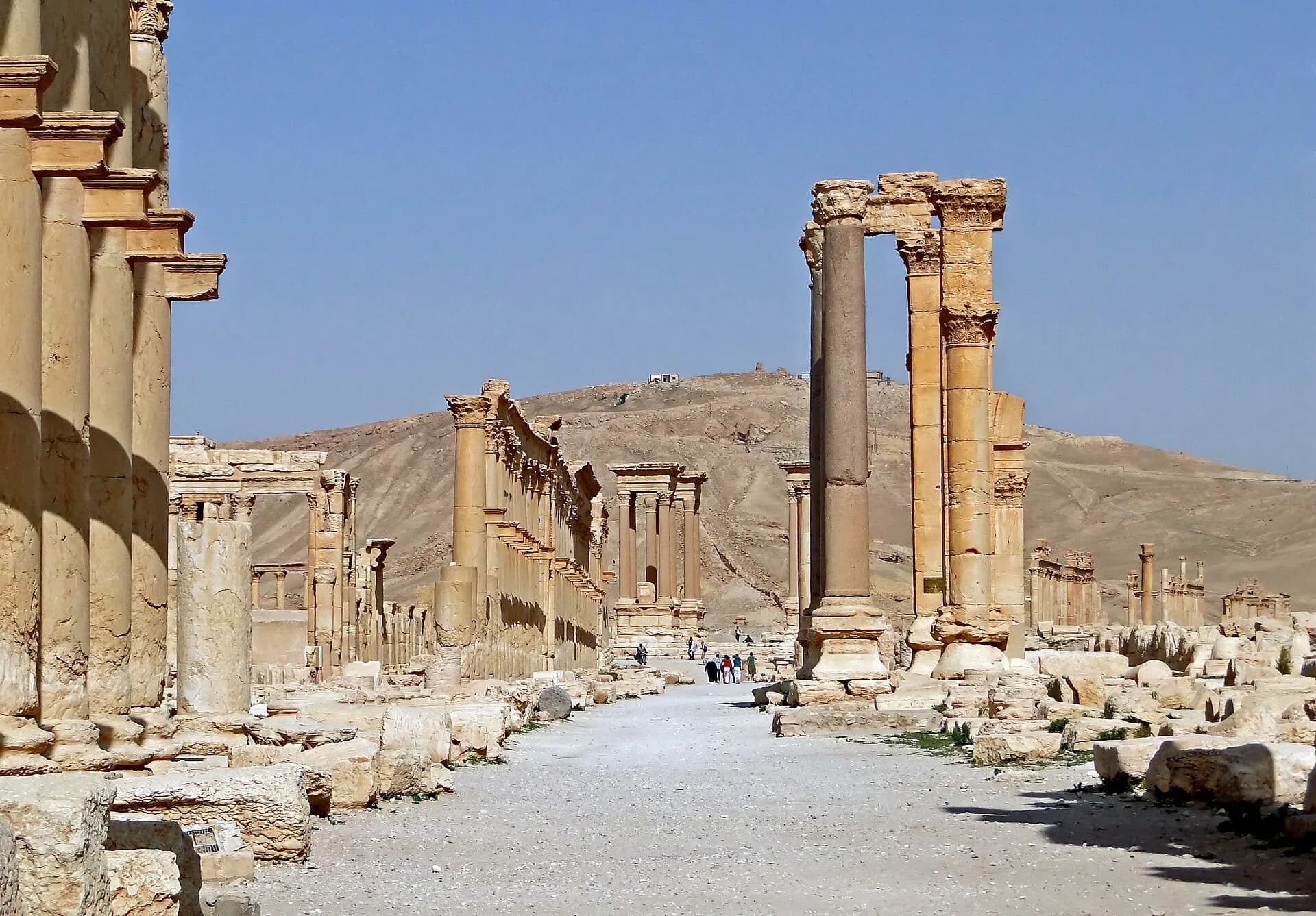
In an oasis in the Syrian desert, about 215 kilometres north-east of Damascus, Palmyra grew rich on the caravan trade between the Roman Empire and the East, and under Queen Zenobia in the third century AD briefly challenged Rome itself. Its long colonnaded street, theatre, agora and the great Temple of Bel, dedicated in AD 32, blended Greco-Roman architecture with local and Persian traditions into something unique, which is why UNESCO listed it in 1980.
Palmyra suffered some of the most deliberate destruction of cultural heritage of the century. Islamic State fighters held the site from May 2015 to March 2016 and again from December 2016 to March 2017. In August 2015 they murdered Khaled al-Asaad, the 82-year-old archaeologist who had looked after the site for decades. They blew up the Temple of Baalshamin and the main sanctuary of the Temple of Bel, leaving only its gateway and outer walls, destroyed several of the famous tower tombs, demolished the Monumental Arch, and in early 2017 wrecked much of the Tetrapylon and the stage façade of the theatre. The site museum was also damaged and its statues smashed. Much of the colonnade survives, and international teams have documented the losses with a view to future restoration.
- 12
Krak des Chevaliers
Photo: Bernard Gagnon, CC BY-SA 4.0, via Wikimedia Commons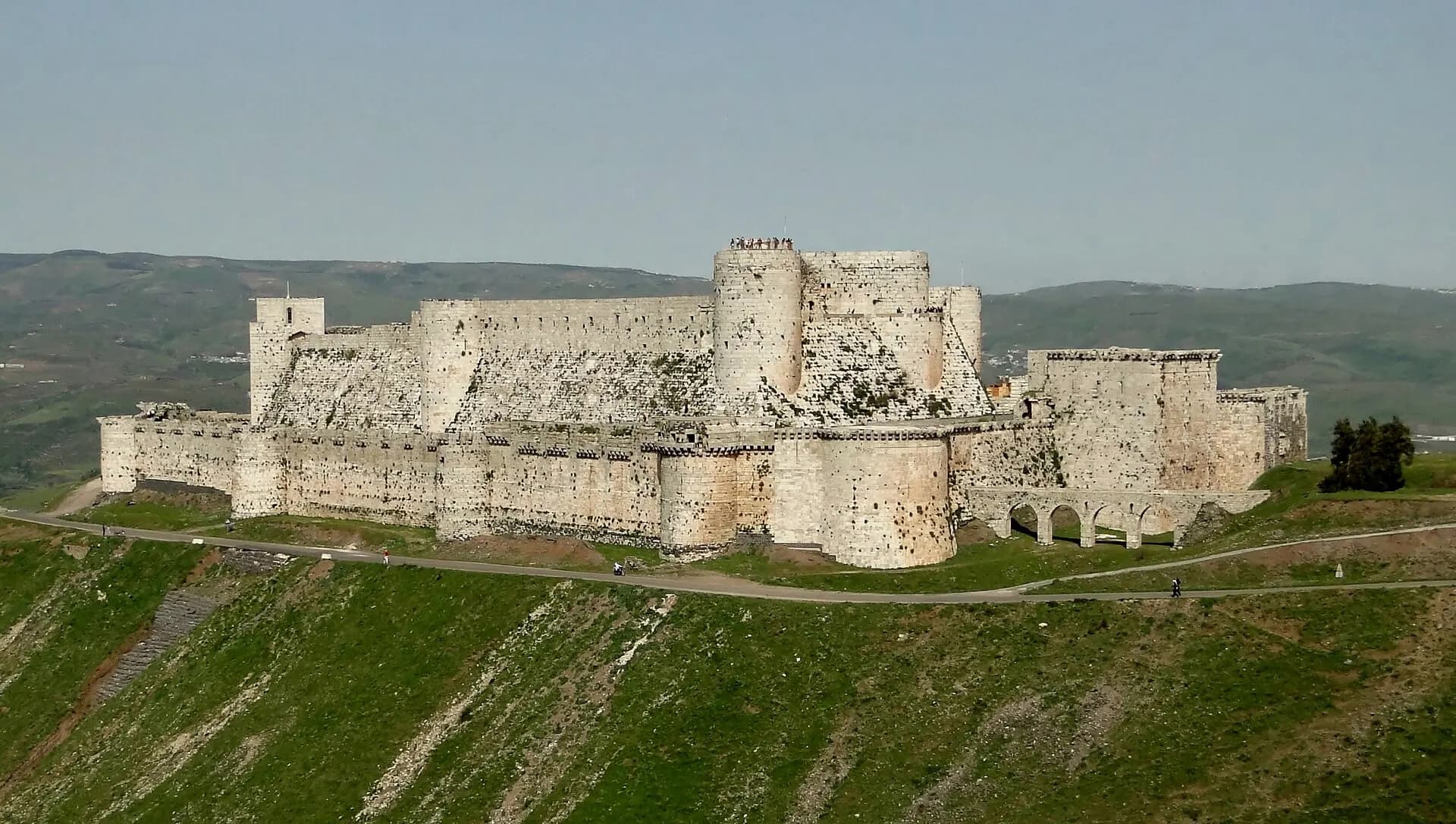
Standing on a ridge above the Homs Gap, the passage between the mountains and the Mediterranean coast, Krak des Chevaliers is perhaps the best preserved crusader castle in the world. The Knights Hospitaller rebuilt it in the twelfth and thirteenth centuries with two concentric rings of walls and massive round towers, and the Mamluk sultan Baybars took it in 1271. T. E. Lawrence, who studied it as a young man, called it perhaps the most wholly admirable castle in the world. Inside are a Gothic loggia, a chapel turned mosque and vaulted halls.
The castle was occupied by opposition fighters and hit by shelling and airstrikes before government forces retook it in 2014; UNESCO, which lists it with the Qal'at Salah El-Din fortress, recorded damage to towers and interior structures, and some repair work has since taken place.
- 13
Norias of Hama
Photo: Vyacheslav Argenberg, CC BY 4.0, via Wikimedia Commons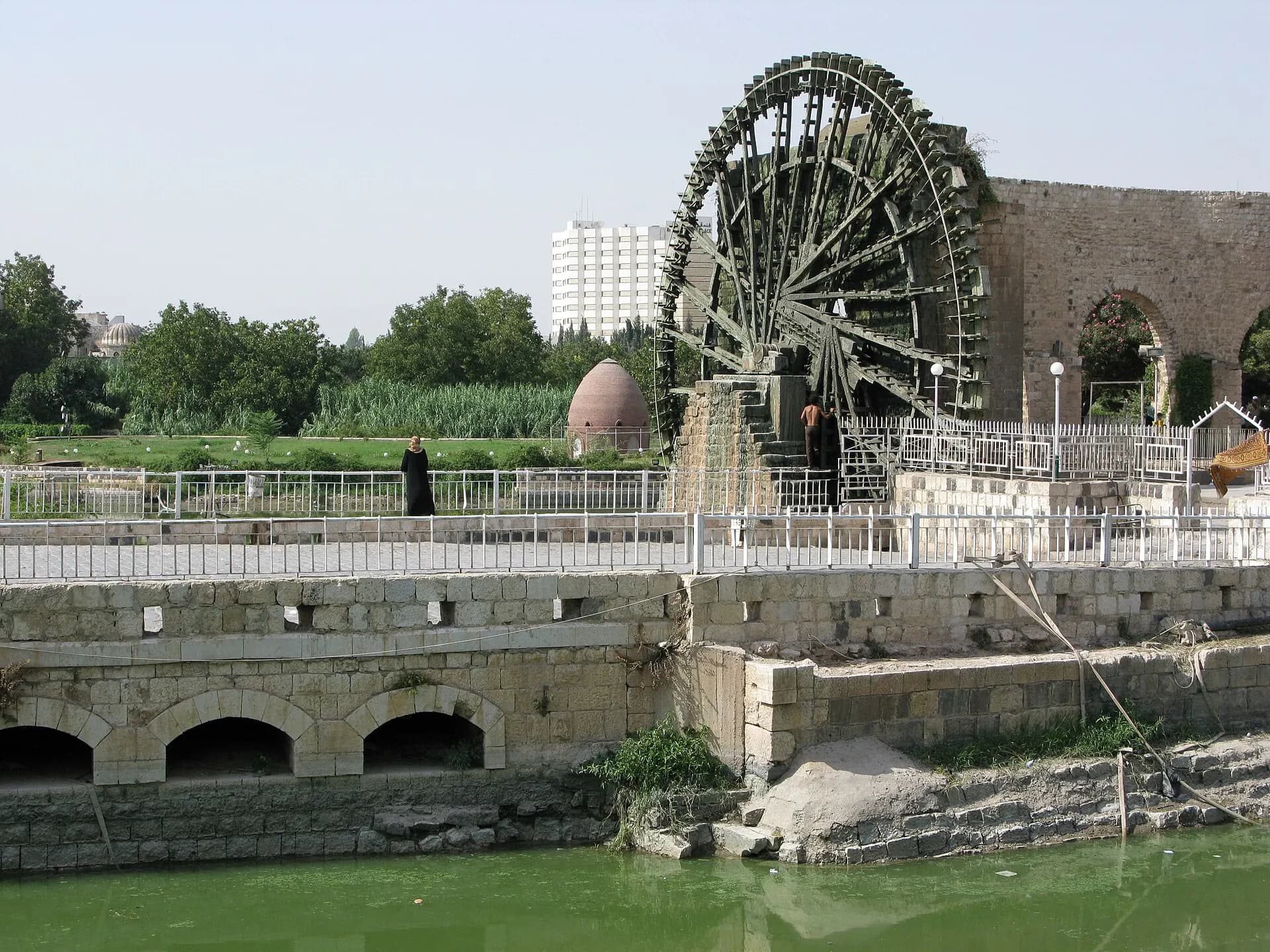
Along the Orontes river in the city of Hama, enormous wooden water wheels, some around 20 metres in diameter, turn slowly in the current, lifting water into stone aqueducts that once irrigated gardens and supplied houses and mosques. Wheels have turned here since at least the Byzantine period, and the surviving ones mostly date from the Ayyubid and Mamluk eras onwards, rebuilt many times. The creaking, groaning sound they make as they turn is one of the most memorable things about the city.
Several norias were reported damaged or left idle during the war years, and Hama's old quarters still bear the scars of the government's assault on the city in 1982.
- 14
Apamea
Photo: Bernard Gagnon, CC BY-SA 3.0, via Wikimedia Commons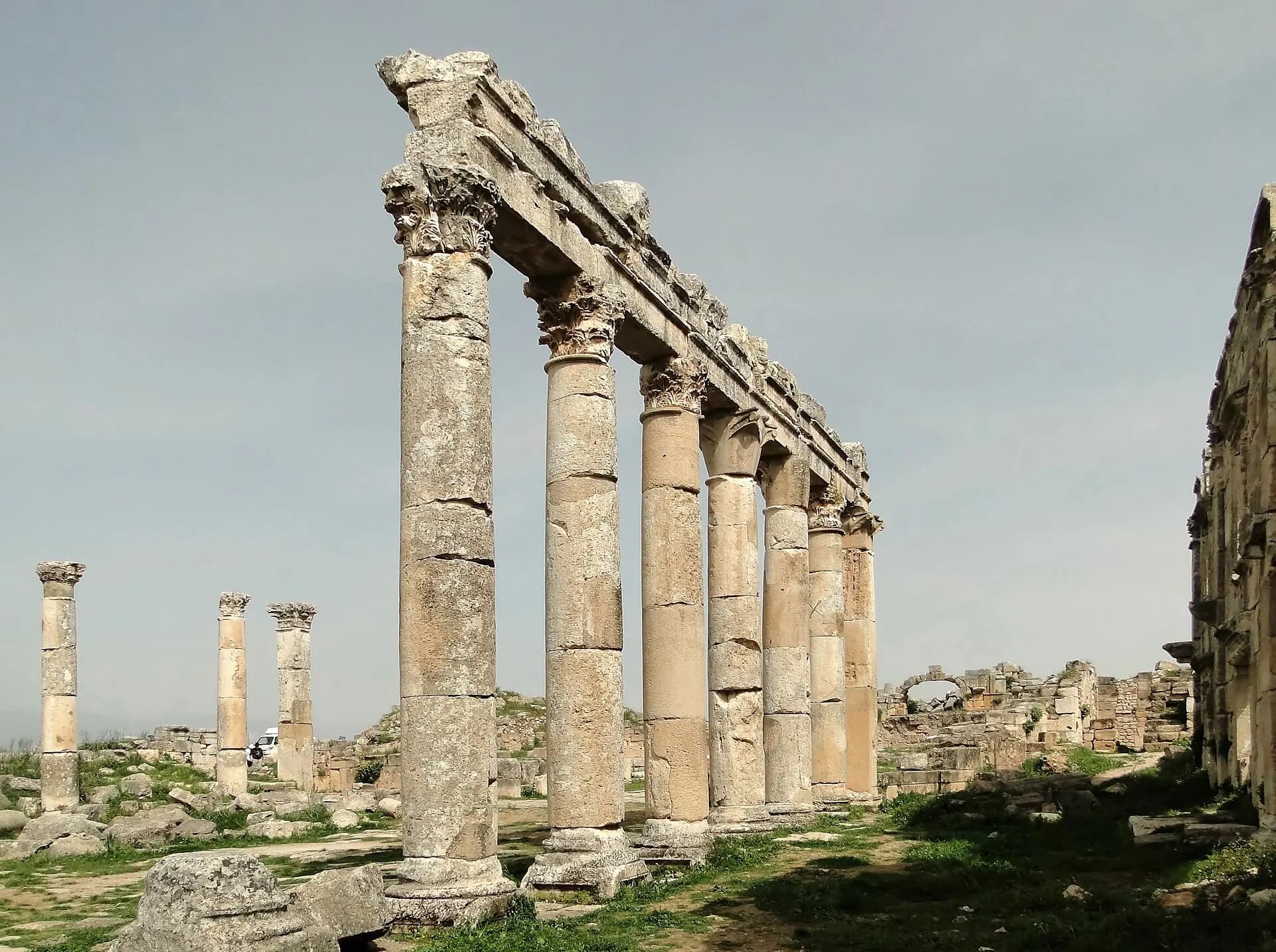
Founded by the Seleucid kings after the death of Alexander the Great, Apamea became one of the great cities of Roman Syria, and its main colonnaded street, almost two kilometres long, is among the longest in the Roman world. Many of the columns, some with spiralling fluted shafts, were re-erected by archaeologists in the twentieth century, and they stand in open farmland above the Ghab plain with a medieval castle at Qalaat al-Madiq on the hill nearby.
Apamea became one of the most widely cited examples of wartime looting in Syria: satellite images taken from 2012 onwards showed the site pitted with thousands of illegal excavation holes.
- 15
Aleppo Citadel
Photo: Bernard Gagnon, CC BY-SA 3.0, via Wikimedia Commons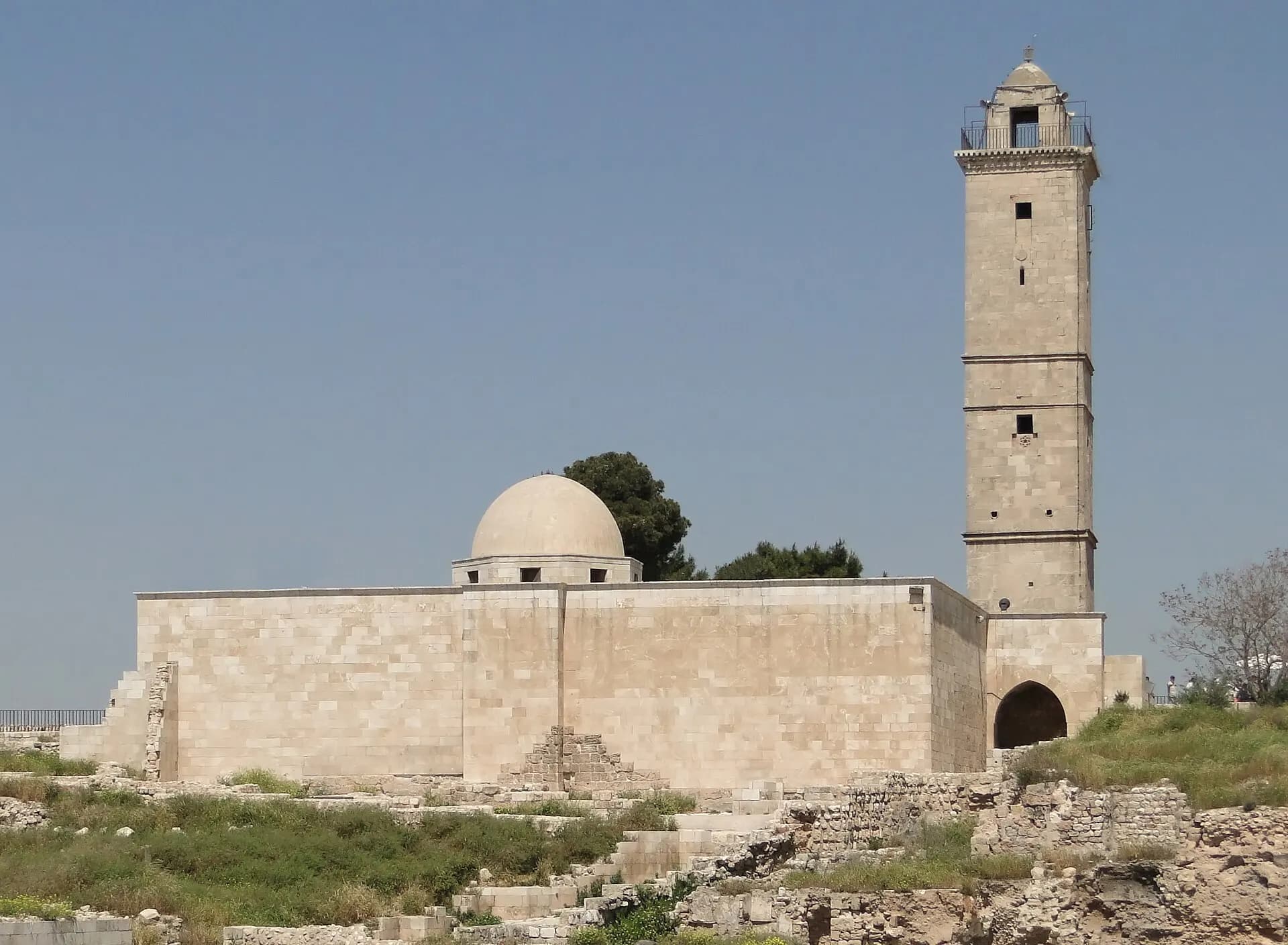
Rising on a vast mound above the centre of Aleppo, the citadel has been fortified since antiquity; its present walls, moat and towering gateway, approached by a stepped bridge, are largely the work of the Ayyubid ruler az-Zahir Ghazi around 1200, with Mamluk additions. Inside are mosques, a palace with a fine throne hall and the remains of a Hittite-era temple. Below it spread Aleppo's old souqs, once among the largest covered markets in the world, and the Umayyad Mosque of Aleppo.
The Ancient City of Aleppo was badly damaged during the battle for the city from 2012 to 2016. Large sections of the souqs burned in 2012, the eleventh-century minaret of the Great Mosque collapsed in 2013, and the citadel's gate was hit by shelling and its walls damaged by a tunnel bomb in 2015. The earthquake of 6 February 2023 caused further damage to the citadel, including its entrance tower. Restoration of the souqs and parts of the citadel has been under way, with the citadel reopening to visitors in 2024 after repairs.
Safety and current advice
Both the UK and US governments advise against all travel to Syria, and neither can offer consular help inside the country. The UK FCDO advice, still current at 27 October 2026, cites unpredictable security conditions, a very high threat of kidnapping by terrorist groups such as Islamic State and al-Qaeda-linked groups, criminal kidnapping for ransom, and the possibility of fighting, artillery fire and airstrikes that are hard to predict. It warns that landmines and unexploded weapons remain from the conflict, especially in rural and less populated areas, and advises staying on roads and paved surfaces. Roads can be blocked without warning, checkpoints are common and driving after dark is especially risky.
The FCDO also notes that political parties are banned and unlicensed political activity restricted, that demonstrations can turn violent, and that journalists and foreigners face a higher risk of detention or of having equipment confiscated. Photographing security or military sites is dangerous. Regional tensions across the Middle East can close airspace at short notice. The US advisory, reissued on 23 October 2026, stays at Level 4 and lists terrorism, unrest, kidnapping, hostage taking, crime and armed conflict.
If you are reading this because you are considering a trip, start with the latest pages from your own government, talk to your insurer, and treat any operator's assurances with caution. Situations described here may already be out of date.
When to go
When official advice permits travel, spring and autumn are the most comfortable seasons. From April to May the hills around Damascus are green and the desert is at its mildest, which matters for Palmyra and Bosra, where there is little shade. Late September to early November brings warm days and cool evenings. Summer in Damascus is hot and dry, with afternoon temperatures commonly in the mid-thirties Celsius, and the desert is hotter still. Winter can be surprisingly cold, with frost and occasional snow in Damascus and the mountains, though it is a quiet, atmospheric time in the Old City.
Ramadan changes the rhythm of daily life: restaurants may close during daylight hours, and the evenings come alive after the fast is broken.
Getting around
Getting in. The FCDO says British nationals need a visa, applied for through the official e-visa portal, with processing of about five to seven days at the time of writing, and that passports must be valid for at least three months after arrival. People holding Israeli or Iranian citizenship cannot enter, and evidence of previous travel to Israel may lead to refusal. Commercial flights resumed to Damascus International Airport after the change of government, but schedules are vulnerable to regional disruption. Historically, many visitors entered overland from Beirut, from Amman via the Nasib crossing, or from Turkey; which crossings are open, and to whom, changes frequently.
Within the country. Damascus's Old City is best explored on foot; it is compact, and many lanes are too narrow for cars. Taxis and shared minibuses (serveeces) cover the rest of the city. Between cities, long-distance coaches have traditionally linked Damascus with Homs, Hama and Aleppo along the main north–south highway, but the FCDO describes roads as very dangerous in many areas because of poor maintenance, insecurity and unexploded weapons. Rail services were largely suspended during the war. Visitors to sites such as Palmyra, Krak des Chevaliers or Apamea have usually travelled with a licensed driver and guide, and anyone doing so should understand that no guide can remove the risks set out in official advice.
Local tips
- Carry cash. Syria has been a largely cash economy, and international bank cards have long been unusable because of sanctions and banking restrictions. Even with some sanctions lifted, do not assume your card will work.
- Dress modestly, particularly in mosques, churches and conservative neighbourhoods. Shoulders and knees covered is a sensible baseline for everyone.
- Ask before photographing people, and never photograph checkpoints, soldiers, government buildings or military sites.
- Damascus keeps late hours. Many families eat dinner late, and the Old City's cafés and restaurants are busiest in the evening.
- Arabic is the main language. English and French are spoken by some older and well-educated Syrians, but a few words of Arabic go a long way: marhaba (hello) and shukran (thank you).
- Avoid political conversations with people you have just met, and do not join demonstrations.
- Power cuts have been common for years. Many hotels run generators, but a power bank and a torch are useful.
A city layered in time
Damascus appears in Egyptian records of the second millennium BC, and by the early first millennium BC it was the capital of the Aramaean kingdom of Aram-Damascus. Alexander's successors, then Rome, rebuilt it on a grid that still underlies the Old City. It was an early centre of Christianity, made famous by Paul's conversion, and in 661 it became the capital of the Umayyad caliphate, whose territory stretched from Spain to Central Asia. Although the capital moved to Baghdad under the Abbasids, Damascus remained a centre of scholarship and trade, held by Seljuks, the Ayyubids of Saladin, the Mamluks and, from 1516 to 1918, the Ottomans, when it was the gathering point for the great annual pilgrim caravan to Mecca.
After the First World War, Syria briefly declared an independent kingdom under Faisal before France took control under a League of Nations mandate. Independence came in 1946. The Baath Party took power in 1963, and Hafez al-Assad ruled from 1970 until 2000, followed by his son Bashar. Protests in 2011 turned into a long and devastating war, with hundreds of thousands killed and millions displaced inside and outside the country, before the government fell in December 2024.
Eat and drink
Damascene cooking is one of the great traditions of the Levant. Breakfast is often foul (slow-cooked fava beans with olive oil and lemon) or fatteh, layers of toasted bread, chickpeas, yoghurt and tahini, sometimes topped with pine nuts fried in butter. Mezze tables include hummus, muhammara (red pepper and walnut paste with pomegranate molasses), baba ghanoush, tabbouleh and kibbeh, the bulgur and meat croquettes that come in dozens of regional forms; Aleppo is particularly proud of its versions, including kibbeh cooked with sour cherries.
Street food runs to shawarma, falafel and manakish, flatbreads baked with za'atar or cheese. Damascus is famous for its sweets: pastries soaked in syrup and filled with pistachios or cream, barazek sesame and pistachio biscuits, and the stretchy, mastic-flavoured ice cream of the Hamidiyah souq. Tea and strong cardamom coffee are everywhere, and the courtyard cafés of the Old City, some in restored merchants' houses, have long been the place to linger over a water pipe.
Where to stay
Before the war, the most memorable places to stay were small hotels in restored courtyard houses inside the Old City, particularly around Bab Touma and the Christian quarter, where rooms open onto fountains and orange trees. Larger international-style hotels are found in the modern city, around the districts west of the Old City. The FCDO points out that hotels and places frequented by foreigners can be targets, so security, location and the ability to leave quickly matter more than charm in the current climate.
Heritage and responsible interest
The damage to Syria's heritage is part of a much larger human catastrophe, and responsible interest starts with keeping that in proportion. Never buy antiquities, coins or carved fragments, in Syria or anywhere else: trafficking in looted artefacts has funded armed groups, and buying them is illegal in many countries. Organisations such as UNESCO and national antiquities services have worked to document and protect sites, and much of what can be learned about Palmyra, Aleppo and the others today comes from that careful work.
For travellers drawn to the wider region's Roman and Nabataean heritage while Syria remains off limits, neighbouring Jordan has comparable sites in a more stable setting, among them Petra and the desert landscapes of Wadi Rum.