Gyeongju
The thousand-year capital of the Silla kingdom, where grassy royal tombs, stone pagodas and lantern-lit palace ponds sit in the middle of a modern city.
- Best time to go
- Late March to mid-April for cherry blossom, and October to early November for autumn colour
- Local time
- –
- Currency
- South Korean Won (KRW)
- Reading time
- 8 min
- Language
- Korean
Gyeongju, in the south-east of Korea, was the capital of the Silla kingdom for close to a thousand years, from 57 BC to AD 935, and for much of that time one of the great cities of East Asia. Its rulers were buried under huge grassy mounds that still rise between the streets, and the hills around the city are scattered with temples, pagodas and Buddhas carved into the rock. So much survives that Korea calls it a museum without walls, and three separate World Heritage listings cover Bulguksa Temple and the Seokguram Grotto, the Gyeongju Historic Areas, and Yangdong Folk Village.
The city itself is low-rise and easy-going, with a compact historic centre that you can cover on foot or by bicycle, a lakeside resort district at Bomun, and the temples of Mount Tohamsan to the east. In late 2025 it hosted the APEC leaders' summit, which brought upgraded venues and hotels around Bomun Lake, but the appeal is unchanged: give it at least two days, and stay overnight to see the palace pond lit up after dark.
The top 12 in Gyeongju
- 1
Daereungwon tomb complex
Photo: Basile Morin, CC BY-SA 4.0, via Wikimedia Commons
A park of twenty-three royal tombs, smooth green mounds among pine trees and lawns, right in the centre of town. You can step inside Cheonmachong, the Heavenly Horse Tomb, excavated in 1973, where a cutaway shows how the wooden burial chamber was buried under stones and earth; it is named after a flying horse painted on a birch-bark saddle flap found inside, along with a gold crown. Hwangnamdaechong, a double-mound tomb, is the largest in the park.
TipThe lone magnolia tree between two mounds near the north gate is a famous photo spot, and queues form in spring.
- 2
Hwangnidan-gil
Photo: Seefooddiet, CC BY-SA 4.0, via Wikimedia Commons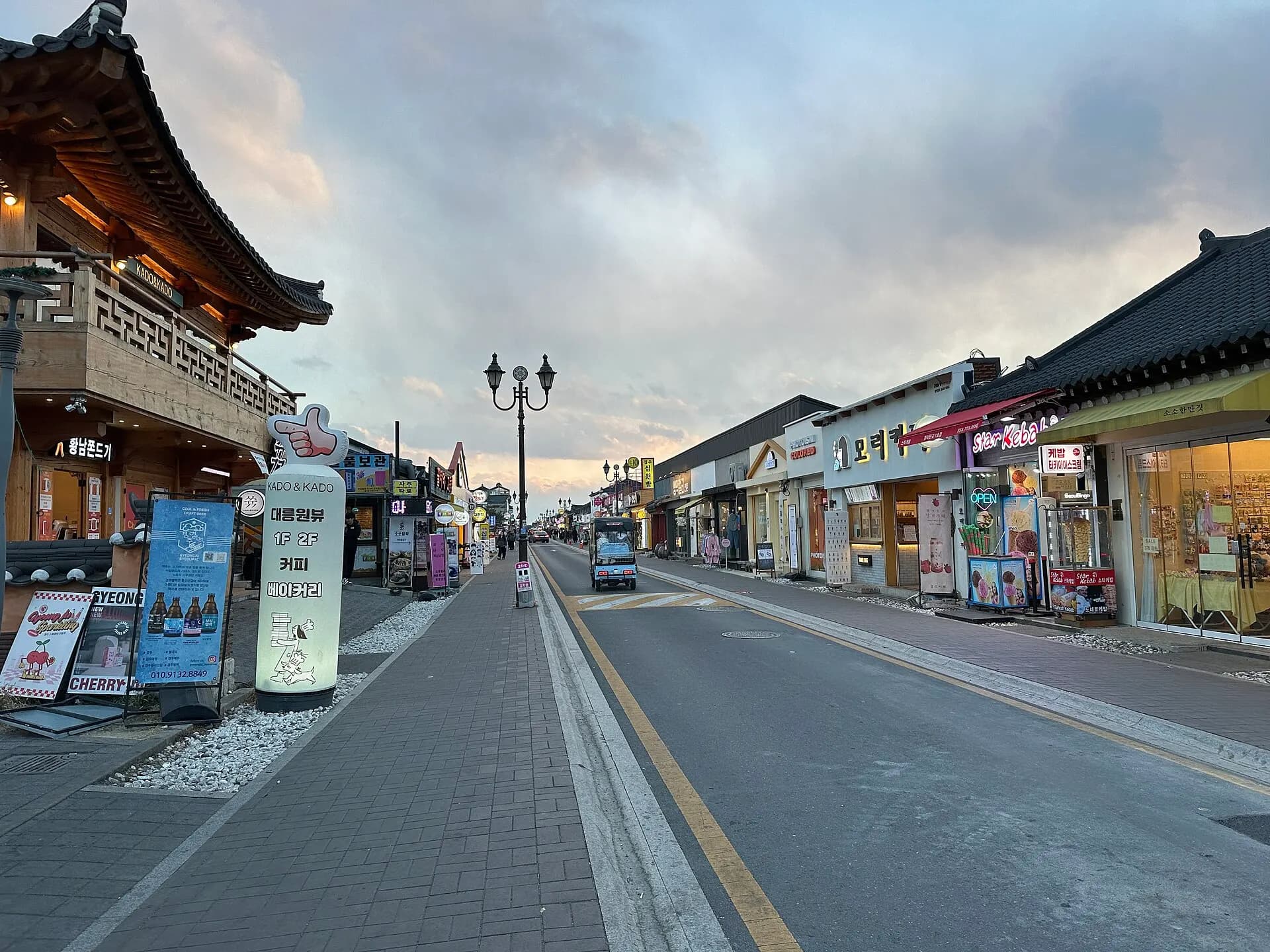
The lanes just west of Daereungwon, once a quiet neighbourhood of old single-storey houses, are now lined with cafés, bakeries, bookshops and small restaurants, many in restored hanok. It is the liveliest part of the city in the evening and at weekends, and a good place for lunch between sights.
- 3
Cheomseongdae and the Wolseong area
Photo: Basile Morin, CC BY-SA 4.0, via Wikimedia Commons
A bottle-shaped stone tower from the seventh century, built in the reign of Queen Seondeok and generally described as the oldest surviving astronomical observatory in East Asia. It stands in open fields that turn pink and gold with flowers in late summer and autumn. A short walk south leads to Gyerim, an ancient wood linked to the founding legend of the Gim royal clan, and Wolseong, the crescent-shaped site of the Silla royal palace, still being excavated.
- 4
Gyochon Hanok Village and Woljeonggyo
Photo: Basile Morin, CC BY-SA 4.0, via Wikimedia Commons
A village of traditional tiled houses on the site of Silla's national academy, best known as the home of the Choi family of Gyeongju, famous for generations of wealth and generosity. Their house is open to visitors. On the river just beyond is Woljeonggyo, a covered Silla bridge rebuilt in timber with a pavilion at each end, beautifully lit at night.
- 5
Gyeongju National Museum
Photo: Abasaa, Public domain, via Wikimedia Commons
The best introduction to Silla, with gold crowns and jewellery from the tombs, Buddhist sculpture, a gallery of finds from Wolji Pond and a garden of stone pagodas and statues. Outside hangs the Divine Bell of King Seongdeok, often called the Emille Bell, cast in 771 and one of the largest bronze bells in Korea. The museum opens from 10 am to 6 pm and closes on New Year's Day, Seollal and Chuseok.
- 6
Hwangnyongsa site and Bunhwangsa
Photo: Abasaa, Public domain, via Wikimedia Commons
The foundations of what was once Silla's greatest temple, whose nine-storey wooden pagoda, around eighty metres tall, burned during the Mongol invasions in 1238. Today, rows of stone bases in a wide field show the scale, and a museum nearby has a model of the pagoda. Next door, Bunhwangsa, founded in 634, keeps part of a stone-brick pagoda guarded by carved lions.
- 7
Donggung Palace and Wolji Pond
Photo: Bernard Gagnon, CC0, via Wikimedia Commons
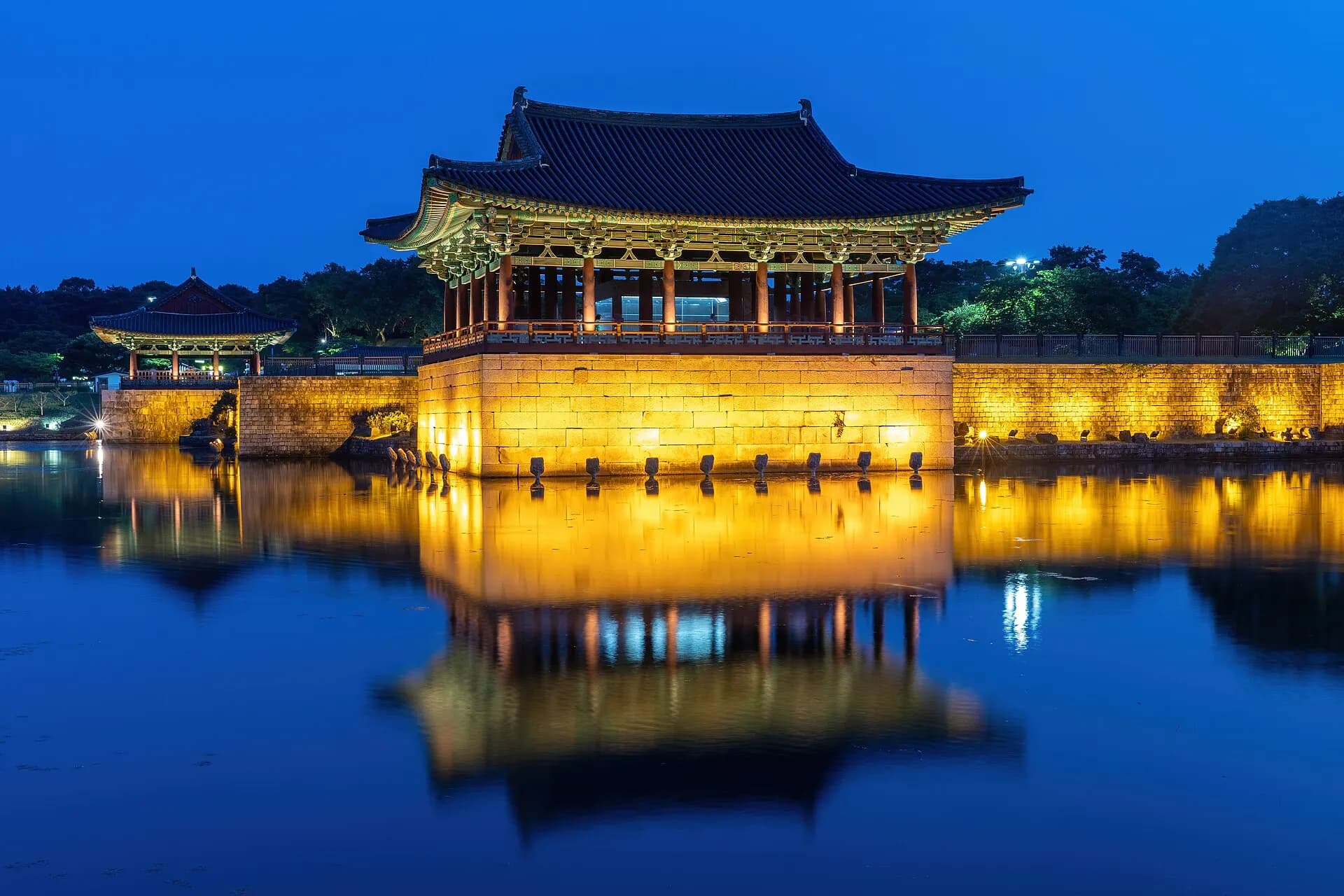
The site of a Silla crown prince's palace, with a pond created in the 670s and pavilions rebuilt on its banks. In the day it is pleasant; after sunset, when the pavilions are floodlit and reflected in the still water, it is the classic image of Gyeongju. Excavations in the 1970s drained the pond and found thousands of objects, now in the National Museum.
TipArrive just before dusk to see it change from daylight to night, and expect crowds on weekend evenings.
- 8
Bomun Lake
Photo: myllissa from Seoul, S. Korea, CC BY 2.0, via Wikimedia Commons
A reservoir east of the city at the heart of a resort district of hotels, a convention centre and a lakeside path lined with cherry trees, which make it one of Korea's best-known blossom walks in early April. It was the main hub of the 2025 APEC summit. Walk or cycle the loop, or rent a swan pedal boat.
- 9
Bulguksa Temple
Photo: Basile Morin, CC BY-SA 4.0, via Wikimedia Commons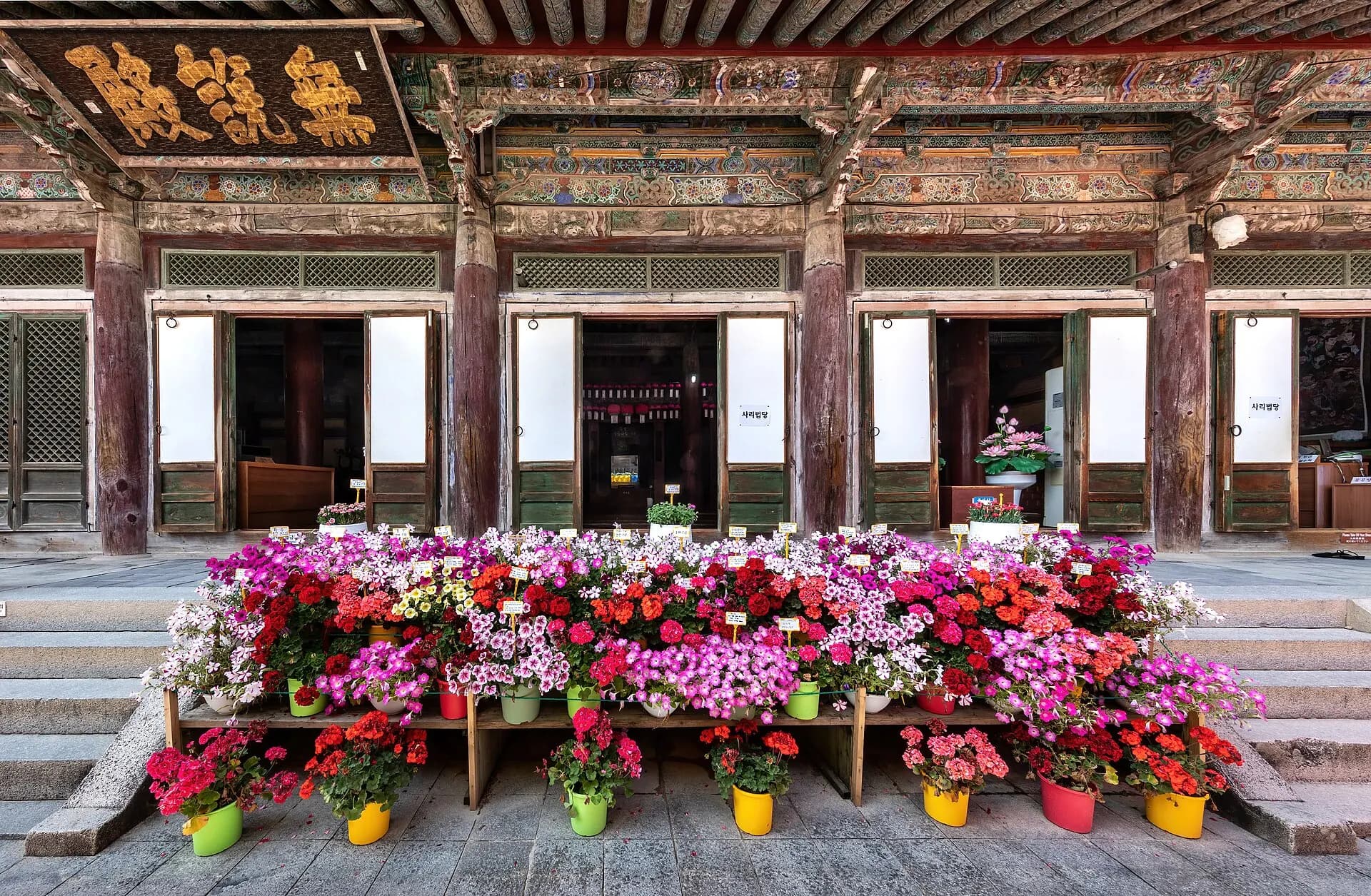
The masterpiece of Silla Buddhist architecture, on the wooded slopes of Mount Tohamsan, first built in the eighth century on stone terraces reached by double staircases, called the Blue Cloud and White Cloud bridges. In the main courtyard stand two contrasting stone pagodas, the elaborate Dabotap and the plain, elegant Seokgatap. With Seokguram, it was among Korea's first World Heritage Sites, listed in 1995.
TipCome early on weekdays to avoid school groups, and look up at the painted eaves and the carvings on the stairways.
- 10
Seokguram Grotto
Photo: Bernard Gagnon, CC0, via Wikimedia Commons
A man-made granite cave temple near the summit of Tohamsan, built at the same time as Bulguksa, where a serene seated Buddha faces east towards the sea, surrounded by carvings of bodhisattvas and guardians. The figure is seen through a glass screen to protect it, and photography inside isn't allowed, but it is one of the finest Buddhist sculptures in Asia. On clear mornings, the views from the ridge reach the East Sea.
- 11
Namsan
Photo: Bernard Gagnon, CC0, via Wikimedia Commons
A mountain south of the city that Silla treated as sacred, with more than a hundred temple sites and dozens of Buddhas and pagodas carved into rock faces and boulders along its valleys. The most popular trail climbs Samneung Valley, past three royal tombs in a pine forest and a series of rock-carved Buddhas, to Geumobong peak, at 468 metres; allow half a day.
- 12
Yangdong Folk Village
Photo: Bernard Gagnon, CC0, via Wikimedia Commons
A living village of tiled and thatched houses spread across wooded hills about sixteen kilometres north of the city, founded by two clans, the Son and the Yi, in the fifteenth and sixteenth centuries. Families still live here, and with Hahoe in Andong it was listed as a World Heritage Site in 2010 as one of the best-preserved Joseon clan villages in Korea.
When to go
Spring is the most popular season: cherry blossom usually peaks in late March or early April, around Bomun Lake, Daereungwon and the roads to Bulguksa, followed by rapeseed flowers near Cheomseongdae. Autumn brings clear skies and red and gold leaves at Bulguksa and on Tohamsan from mid-October into early November. Summers are hot and humid, with a rainy season in July, and winters are cold but mostly dry and much quieter. Weekends and public holidays get very busy, so plan the big sights for weekdays.
Getting around
KTX high-speed trains run to Gyeongju Station, which until 2021 was called Singyeongju and is still sometimes listed under that name. It is about two hours and ten minutes from Seoul, around twenty minutes from Dongdaegu and half an hour from Busan. The station is outside the city, about twenty minutes by bus or taxi from the centre. Express buses from Seoul, Daegu and Busan arrive at the Gyeongju Express Bus Terminal, a short walk from Hwangnidan-gil. The historic centre is flat and best seen on foot or by rented bicycle; city buses 10 and 11 loop between the centre, Bomun and Bulguksa, and bus 12 climbs from Bulguksa to Seokguram. Taxis are useful for Namsan and Yangdong.
Local tips
- Check whether you need a K-ETA before travelling to Korea.
- Use a Korean map app for buses and walking routes; international map apps are patchy.
- A T-money card works on Gyeongju buses as well as in other cities.
- Bulguksa and Seokguram no longer charge admission, but some sites, including Donggung and Wolji and Cheonmachong, still do; check before you go.
- Stay overnight to see Wolji Pond, Woljeonggyo and Cheomseongdae lit up after dark.
- Yangdong and Gyochon are lived-in villages: keep your voice down and don't enter houses or courtyards unless signed as open.
- Dress modestly and speak quietly in temple halls, and don't photograph people praying.
- The 1330 Korea Travel Hotline answers questions in English around the clock.
Eat and drink
Gyeongju's best-known snack is Gyeongju bread, or Hwangnam-ppang, a small round pastry filled with sweet red-bean paste, sold in bakeries across the centre, along with chalboribbang, barley pancakes sandwiched with red bean. For a meal, try ssambap, a spread of rice, side dishes and leaves for wrapping, served in many restaurants near Daereungwon, and soft tofu dishes. Gyochon is known for Gyodong Beopju, a traditional rice wine made by the Choi family, and Hwangnidan-gil has dozens of cafés in old hanok.
Where to stay
The area around Hwangnidan-gil and Gyochon has hanok guesthouses, some with heated floors and sleeping mats, within walking distance of the main sights. Bomun Lake has the large resort hotels, convenient for a quieter stay and the blossom walks but a bus ride from the centre. A few guesthouses near Bulguksa suit an early start at the temple.
The Silla kingdom
Silla began as a small state in the south-east of the peninsula and, allied with Tang China, defeated its rivals Baekje and Goguryeo in the 660s to unite most of Korea. In the centuries that followed, Gyeongju grew into a city of palaces and temples, linked by trade to China, Japan and, through them, the Silk Road. Silla's elite was organised by a strict bone-rank system, its goldsmiths made some of the finest crowns in the ancient world, and its kings embraced Buddhism, which shaped the art you see across the city. The kingdom weakened in the ninth century and surrendered to the new state of Goryeo in 935, after which Gyeongju became a provincial town, a decline that helped preserve its tombs and temple sites.
Buddhist art in Gyeongju
Buddhism became Silla's state religion in the sixth century, and much of Gyeongju's heritage is Buddhist. Granite was the material of choice, carved into pagodas, lanterns and statues that have lasted far longer than wooden halls. Bulguksa and Seokguram show the high point of the eighth century, designed as a vision of the Buddha's paradise, while Namsan preserves a more intimate side, with Buddhas carved by unknown monks into boulders along mountain paths. The National Museum's outdoor garden is a good place to see the range of styles side by side.
Gyeongju and the 2025 APEC summit
From 31 October to 1 November 2025, Gyeongju hosted the leaders' meeting of the Asia-Pacific Economic Cooperation forum, centred on the Hwabaek Convention Center (HICO) in the Bomun resort area. Roads, hotels and visitor facilities were upgraded for the event, and the city has used the attention to promote itself as a conference destination, but the summit left the historic centre largely unchanged.
Responsible travel
Gyeongju's tombs, temple sites and fields are archaeological sites, many still under excavation. Stay on paths, don't climb the tomb mounds or touch carvings, and don't take stones or fragments. Seokguram, Bulguksa and the Namsan hermitages are active places of worship, so keep noise down and follow signs. Visit on weekdays where you can, and use the train, buses or bicycles rather than driving around the centre.