Split
A living city inside a Roman emperor's palace, with pine-covered hills, island ferries and the whole central Dalmatian coast on its doorstep.
- Best time to go
- May to June and September to early October, for warm seas, open ferries and fewer crowds; July and August are hot and busy
- Local time
- –
- Currency
- Euro (EUR)
- Reading time
- 14 min
- Language
- Croatian
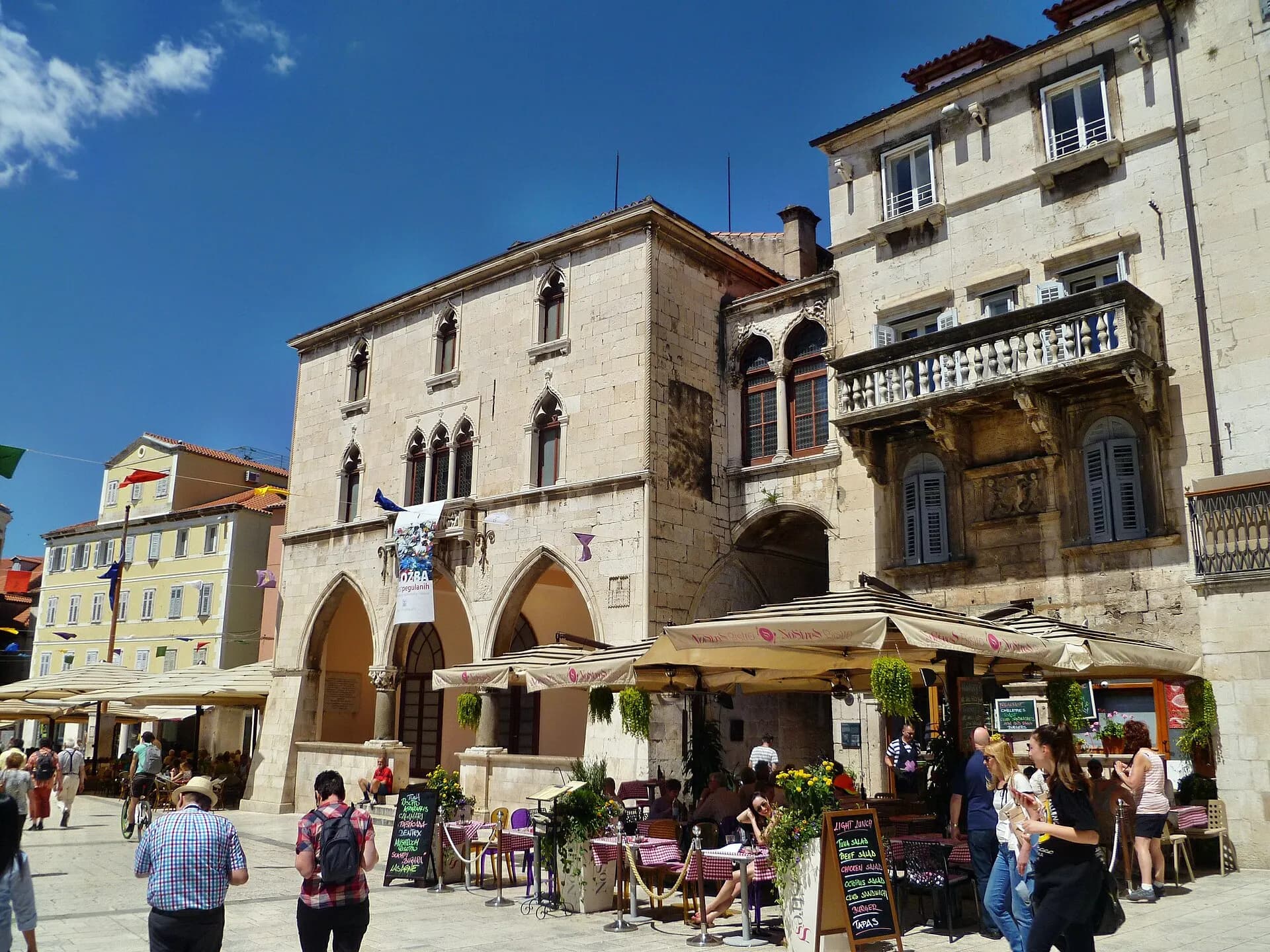
Around the year 300, the Roman emperor Diocletian, a man born locally in Dalmatia, built himself a vast fortified retirement home on the shore of a sheltered bay. When the nearby Roman city of Salona fell in the seventh century, refugees moved inside its walls, and they never left. Today the palace is not a ruin you visit but a neighbourhood you walk through: cafés fill the ceremonial courtyard, washing hangs between Roman columns, and the emperor's mausoleum has been a cathedral for well over a thousand years. Together with the medieval town that grew around it, it is a UNESCO World Heritage Site.
Split is Croatia's second city and the main transport hub of the Dalmatian coast, so most visitors pass through on the way to the islands. That is a mistake worth avoiding. Give the city two full days, then use it as a base: Trogir, Klis and Omiš are short bus rides away, Krka's waterfalls make a long day trip, and ferries and catamarans run to Brač and Hvar from the harbour just beside the old town. The places below run from the city outwards, finishing on the islands, which is a sensible order for a week. Further down the coast, our Dubrovnik guide picks up the story, and inland to the north lie the Plitvice Lakes.
The top 13 in Split
- 1
Bačvice
Photo: dronepicr, CC BY 2.0, via Wikimedia Commons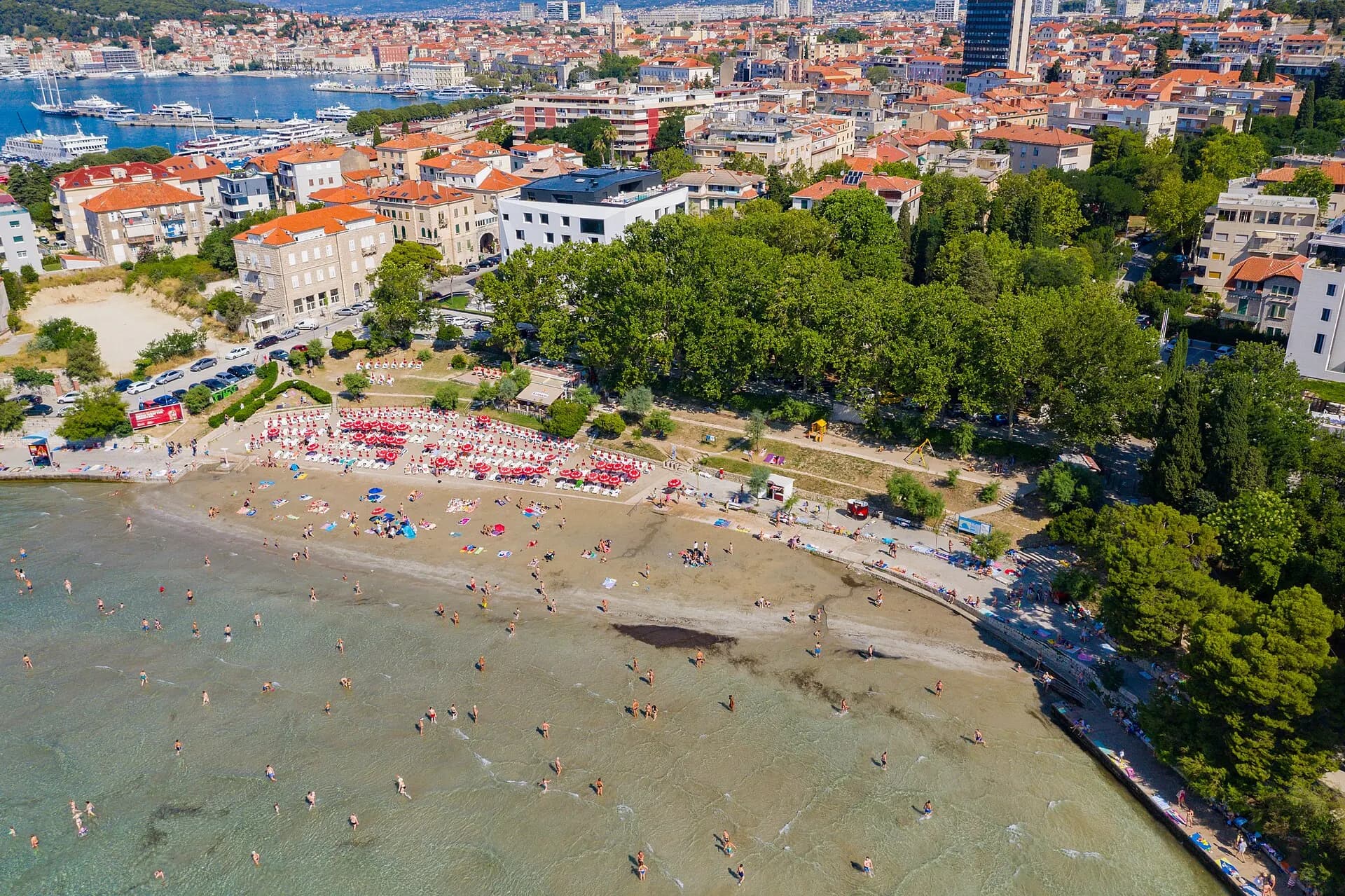
Split's town beach is a shallow, sandy curve a ten-minute walk east of the palace, and it is where the city goes to cool off. It is also the home of picigin, a local game in which players stand in knee-deep water and keep a small ball in the air with flat-handed slaps and theatrical dives. Nobody wins; the point is to look good doing it. The water stays shallow for a long way, which makes it popular with families, and the promenade above has cafés and bars that stay busy late into summer nights.
It gets very crowded on hot weekends. For clearer water and more space, carry on east along the coast path to the smaller coves beyond, or head west to the beaches below Marjan.
TipCome early in the morning to watch locals swim their daily laps before the crowds and the heat arrive.
- 2
The Riva
Photo: Silverije, CC BY-SA 3.0, via Wikimedia Commons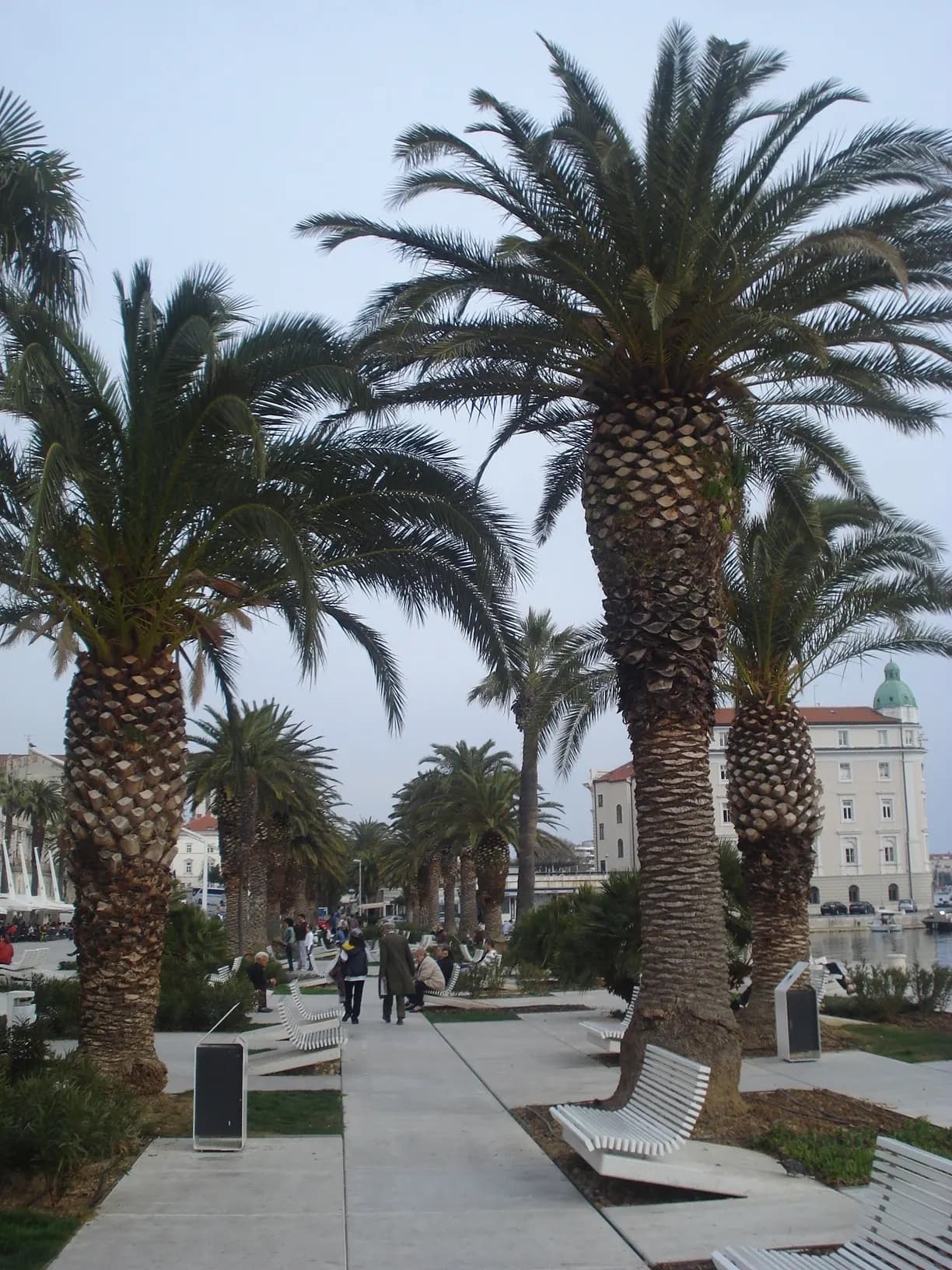
The broad seafront promenade runs along the palace's southern wall, lined with palms, white benches and café terraces. In Roman times the sea came right up to this façade, and the emperor's private apartments looked straight out over the water. Today it is the city's living room, where people meet for coffee in the morning, walk in the evening and gather for concerts, festivals and New Year celebrations.
At the western end, the Riva opens onto the harbour and the old fishermen's quarter, and the main ferry port and bus and train stations lie a short walk to the east, which makes the Riva the natural place to start and end any day.
- 3
Diocletian's Palace cellars
Photo: Bernard Gagnon, CC BY-SA 4.0, via Wikimedia Commons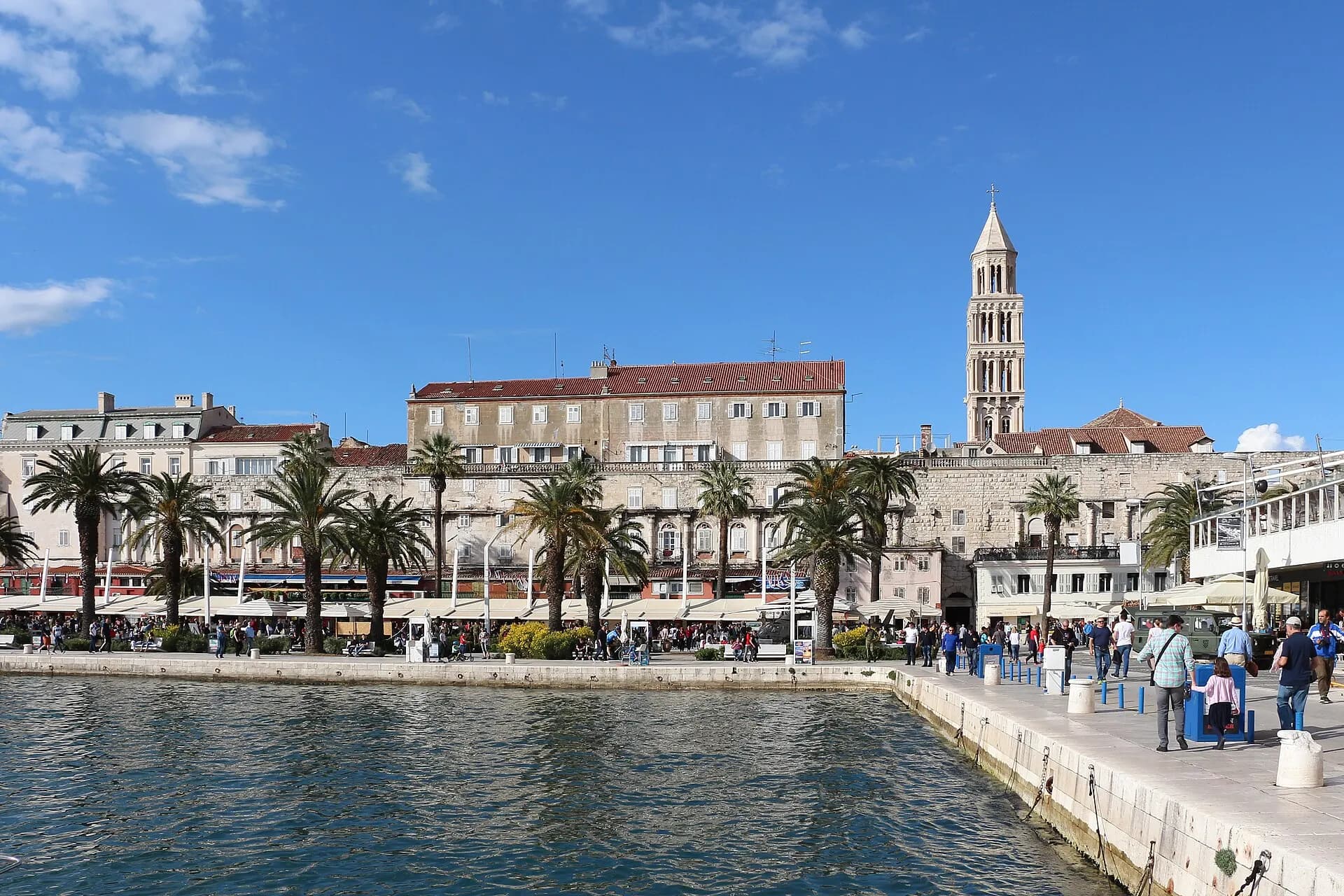
Because the palace was built on sloping ground, its southern half stood on a huge set of vaulted halls, and these substructures mirror the layout of the imperial rooms that once stood above them. For centuries the townspeople used them as a rubbish dump, which filled them up and, by accident, preserved them almost intact. Excavated in the twentieth century, they are among the best-preserved Roman basement complexes anywhere, and they give the clearest sense of the palace's original scale.
The central passage, entered from the Riva through the Bronze Gate, is free and lined with souvenir stalls; the side halls, with their massive stone piers and exhibits, require a ticket. Fans of Game of Thrones will recognise them as the place where Daenerys kept her dragons.
- 4
The Peristyle
Photo: TimeTravelRome, CC BY 2.0, via Wikimedia Commons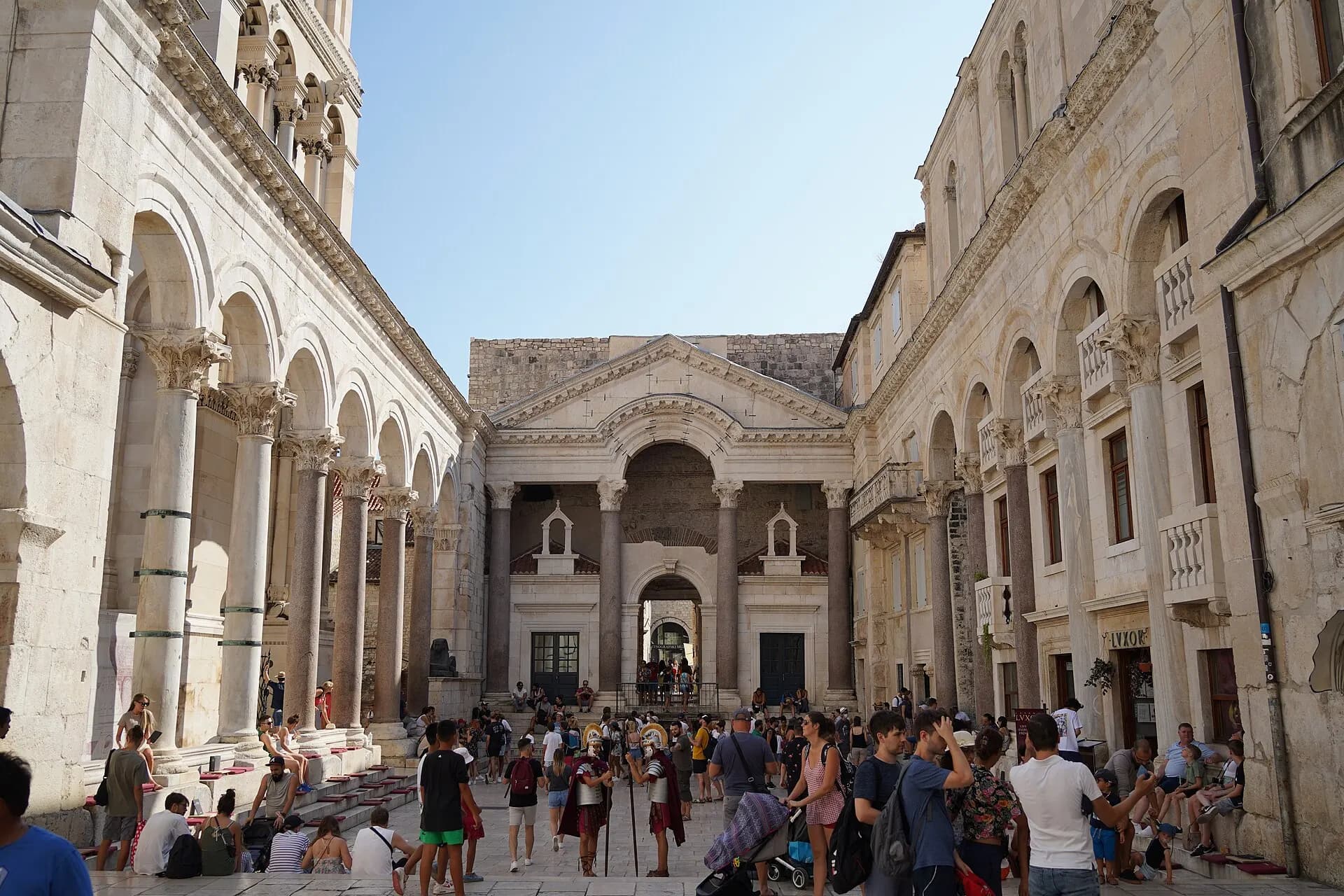
The palace's ceremonial courtyard is framed by granite and marble columns and arches, with the entrance to the emperor's private quarters at its southern end. Here Diocletian, who presented himself as a living god, would have appeared before his subjects. Above the courtyard a domed vestibule, open to the sky, has acoustics good enough that singers often perform inside it.
Today the Peristyle is the heart of the old town. In summer, actors in Roman costume stage a changing of the guard, and in the evening people sit on the steps with a drink while music drifts out of the café that occupies part of the colonnade. A black granite sphinx, brought from Egypt for the emperor, still stands to one side.
TipVisit early in the morning or late at night to see the courtyard without the cruise and tour groups.
- 5
Cathedral of St Domnius and bell tower
Photo: Sumitsurai, CC BY-SA 4.0, via Wikimedia Commons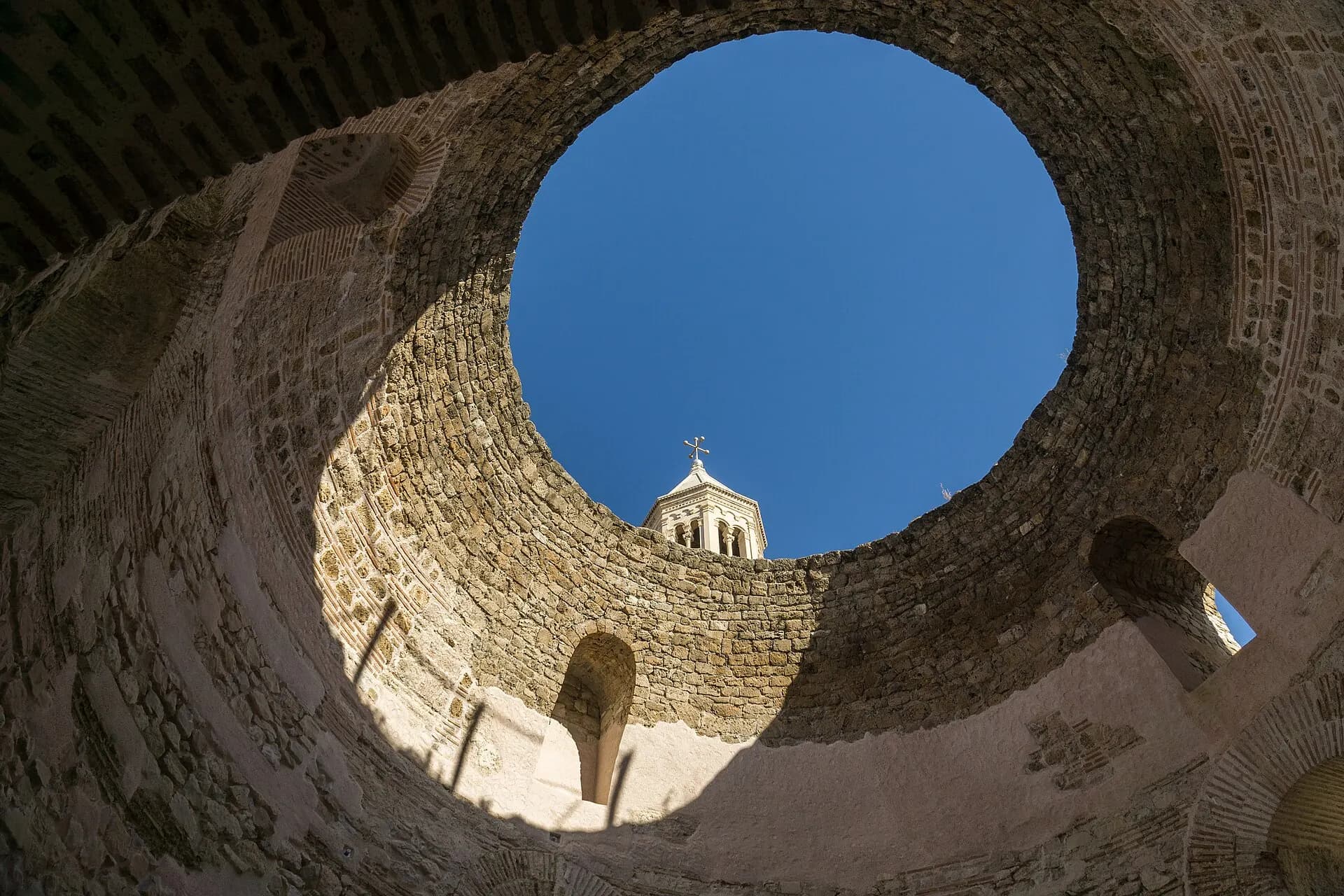
The octagonal building on the east side of the Peristyle was built as Diocletian's mausoleum. In a neat historical irony, the emperor who led one of Rome's harshest persecutions of Christians ended up inside a church dedicated to one of his victims, Domnius, the bishop of Salona, who was martyred in 304. It is often described as one of the oldest buildings in the world still in use as a cathedral. Inside, look for the carved wooden doors by the medieval master Andrija Buvina, the Romanesque pulpit and the frieze around the dome, which is thought to include portraits of the emperor and his wife.
The Romanesque bell tower beside it took centuries to finish. Climbing it involves steep, narrow stairs and an open metal staircase at the top, but the view over the palace roofs, the harbour and the islands is the best in town. Combined tickets usually cover the cathedral, crypt, treasury, the small Temple of Jupiter nearby and the tower.
TipCover shoulders and knees for the cathedral, and climb the tower early, before the stairs fill and the stone heats up.
- 6
Golden Gate and Gregory of Nin
Photo: Fred Romero from Paris, France, CC BY 2.0, via Wikimedia Commons
The palace's main gate, on its northern side, faced the road to Salona and was the grandest of its four entrances. Just outside stands Ivan Meštrović's giant bronze statue of Gregory of Nin, a tenth-century bishop who argued for using the Croatian language rather than Latin in church services. Rubbing the big toe of the statue is said to bring good luck, and it has been polished to a shine by millions of hands.
The park beyond the gate is a pleasant place to sit, and from here the narrow lanes of the medieval town lead west to Narodni trg, the old main square, with its Venetian-era town hall.
- 7
Marjan Hill
Photo: Bernard Gagnon, CC BY-SA 4.0, via Wikimedia Commons
Split's green lung is a forested peninsula of pine and holm oak that rises west of the old town. From the Varoš quarter, steps climb in about fifteen minutes to the first viewpoint, where a café terrace looks straight down over the red roofs, the harbour and the islands. From there, paths continue to the summit of Telegrin, the highest point at about 178 metres, past small medieval chapels and hermitages cut into the rock.
The rest of the peninsula is laced with walking and cycling paths and fringed with rocky beaches, from Kašjuni on the south side to Bene on the northern shore, which are calmer and clearer than Bačvice. It's easy to spend half a day here.
TipWalk up for sunset, when the islands turn blue and the city lights come on below.
- 8
Trogir
Photo: Rigorius, CC BY-SA 4.0, via Wikimedia Commons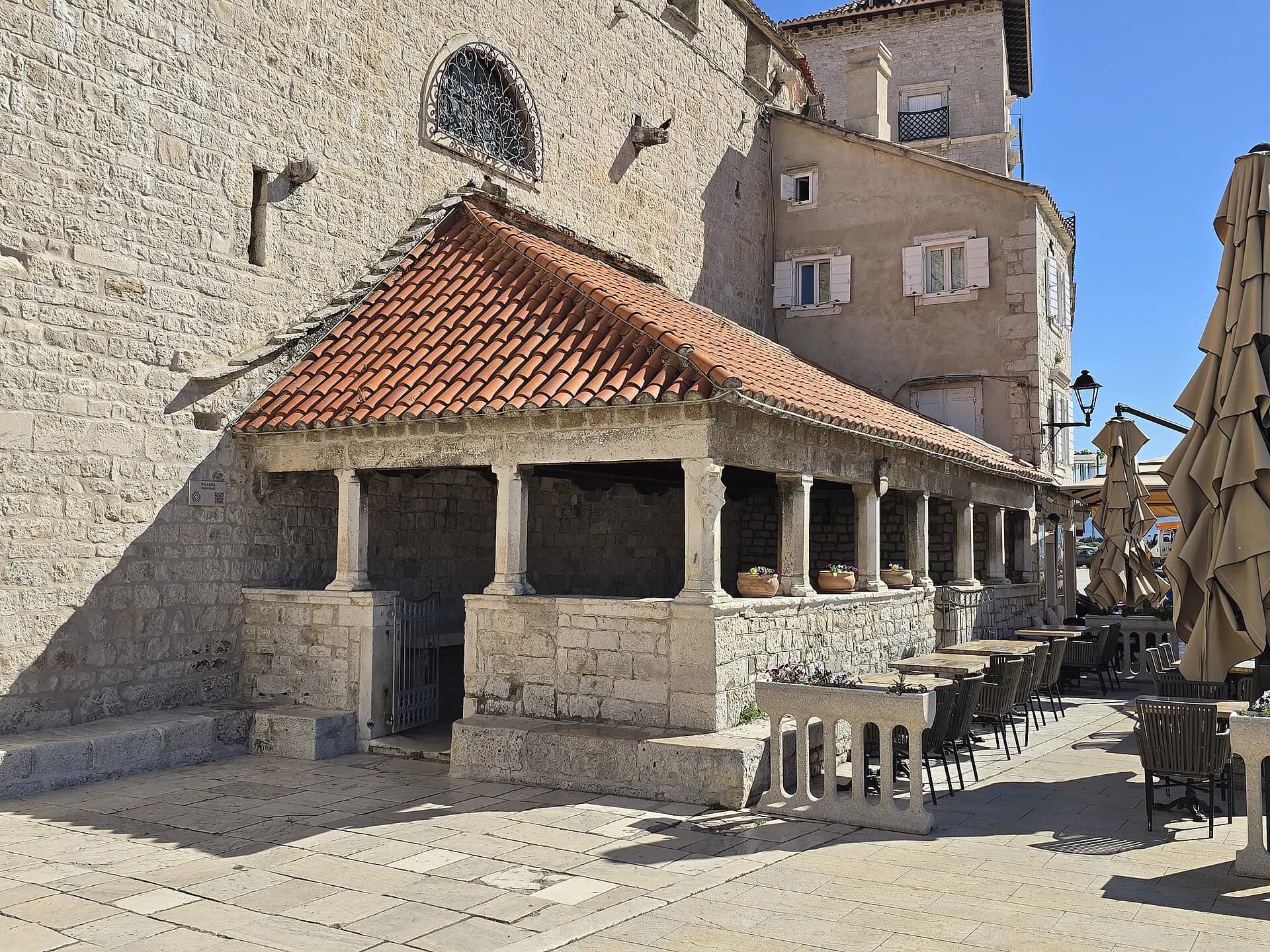
Half an hour west of Split, Trogir is a tiny walled town on an island between the mainland and the island of Čiovo, linked to both by bridges. Its compact grid of streets dates back to the Greek settlers who founded it, and its Romanesque and Renaissance buildings are so well preserved that the whole historic centre is a UNESCO World Heritage Site. The highlight is the Cathedral of St Lawrence, whose main portal, carved by the master Radovan in the thirteenth century, crowds Adam and Eve, saints, lions, labouring peasants and sea creatures into one extraordinary doorway.
Walk the waterfront promenade to the Kamerlengo Fortress at the western tip, and climb its walls for views back over the town. Trogir is close to Split airport, so it also makes a good first or last night.
TipLocal buses run frequently from Split, and in summer small boats link Trogir and Split along the coast.
- 9
Krka National Park
Photo: Skot, CC BY-SA 4.0, via Wikimedia Commons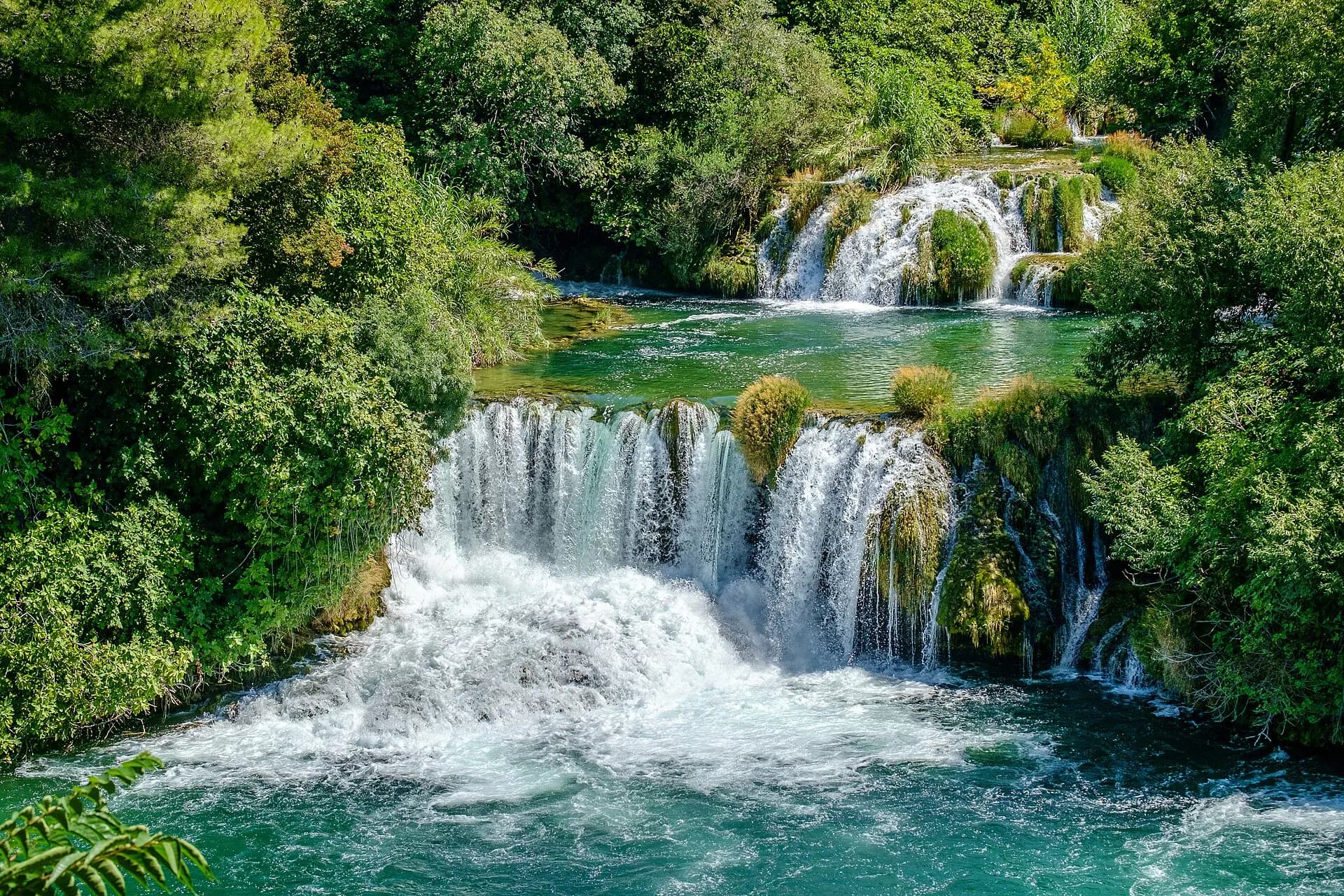
The Krka River cuts a deep canyon through the limestone on its way to the sea near Šibenik, and along the way it tumbles over a series of travertine barriers, built up over millennia as minerals settle on moss and plants. The most famous is Skradinski buk, a broad, many-tiered cascade of white water and green pools, circled by a wooden walkway and old watermills. Further upstream, park boats run to Visovac, a tiny island with a Franciscan monastery, and to Roški slap, a wider series of falls with smaller cascades known locally as the necklaces.
The park is about an hour and a half's drive north of Split. The two usual entrances for Skradinski buk are Lozovac, from which a park bus descends to the falls, and the riverside town of Skradin, from which park boats run upstream; both are included in the ticket from April to October. Swimming is no longer allowed at Skradinski buk; in summer it is permitted only at designated spots elsewhere in the park.
TipIn 2026, adult tickets for all sites cost 40 euros from June to September (30 euros after 3pm), 20 euros in April, May and October, and 7 euros in winter. Buying online in advance saves queuing in summer; check the park's webshop for current conditions.
- 10
Klis Fortress
Photo: Bernard Gagnon, CC BY-SA 4.0, via Wikimedia Commons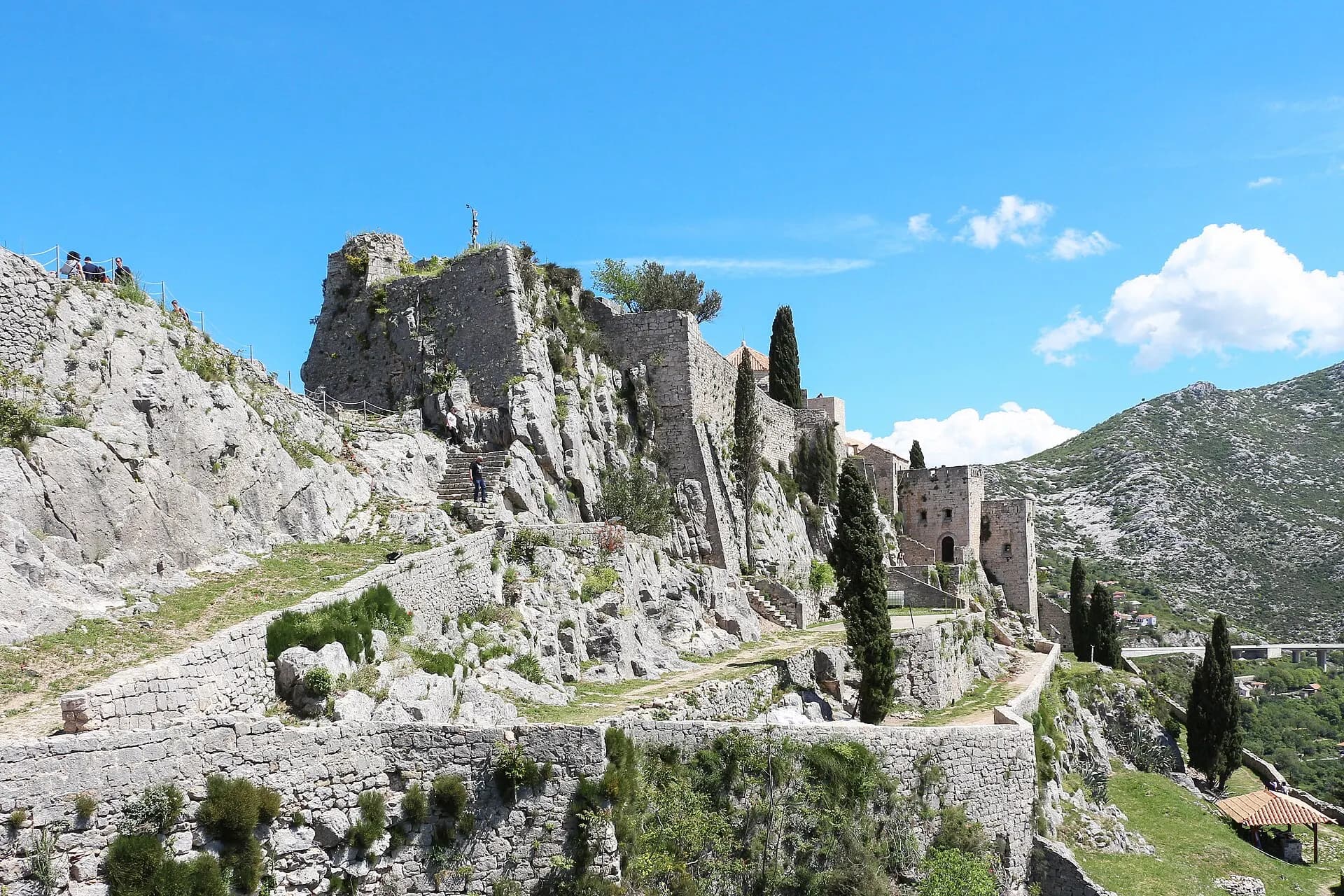
Perched on a narrow ridge above the pass that leads from the coast into the interior, Klis has guarded the approach to Split since at least the early Middle Ages. Croatian kings held it; later, a small band of defenders known as the Uskoks resisted the Ottomans here for years before it fell in 1537. The Venetians recaptured it more than a century later, and the walls you see today are layered with the work of all of them.
The climb up through its three tiers of ramparts rewards you with sweeping views over Split, the islands and the mountains behind. It was used as the city of Meereen in Game of Thrones. Klis is only about twenty minutes from Split by car or local bus.
TipAfterwards, try spit-roast lamb at one of the grill restaurants in the village below, a local speciality.
- 11
Omiš and the Cetina Gorge
Photo: Modzzak, Public domain, via Wikimedia Commons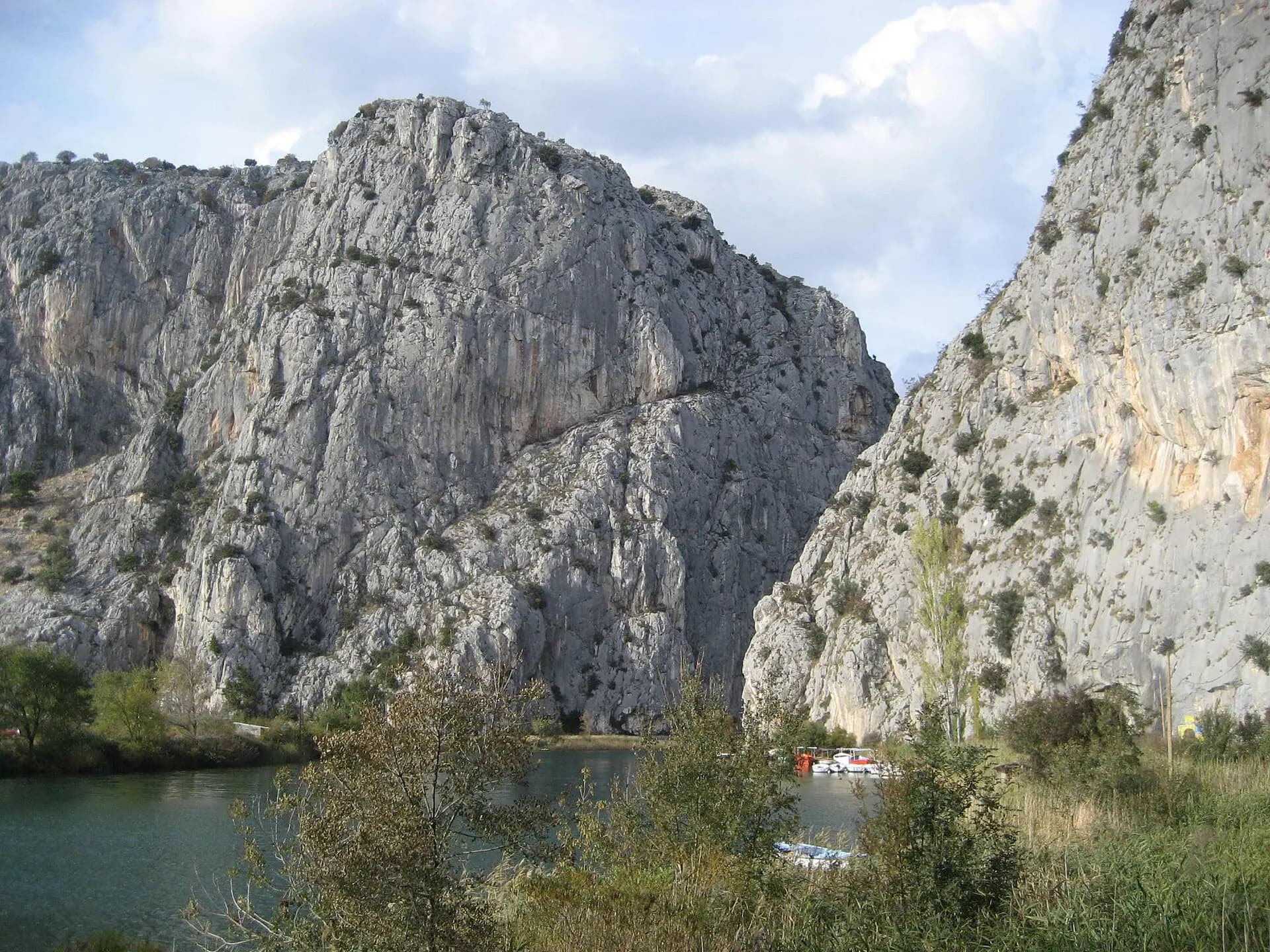
About 25 kilometres south-east of Split, the Cetina River breaks through a dramatic gap in the coastal mountains and meets the sea at Omiš. The town was once a notorious pirate base, whose light, fast ships preyed on passing traffic, Venetian galleys included, in the twelfth and thirteenth centuries. Two fortresses watch over it: Mirabela, just above the old town, and Fortica, high on the cliff, which is a much stiffer climb but gives a magnificent view down the coast.
Upstream, the river winds through a deep green canyon. In summer this is the region's adventure hub, with rafting, canyoning, kayaking and long ziplines across the gorge, as well as gentler boat trips to riverside restaurants serving trout and frog legs.
TipRafting is gentlest and most reliable in summer, when the river level is controlled by upstream dams; book with a licensed operator.
- 12
Zlatni Rat, Bol
Photo: Alex Proimos from Sydney, Australia, CC BY 2.0, via Wikimedia Commons
Croatia's most photographed beach is a long tongue of fine pebbles jutting out into the channel from the south coast of Brač, near the small town of Bol. Its tip shifts with the wind and currents, sometimes pointing east, sometimes west. Pine woods behind the beach give shade, and the steady afternoon breeze funnelling between Brač and Hvar makes it one of the best windsurfing and kitesurfing spots on the Adriatic.
Bol itself is a pretty harbour town with a Dominican monastery on its eastern point. Above it rises Vidova gora, at about 780 metres the highest peak on any Adriatic island, reached by a long hike or a winding road, with a famous view straight down on Zlatni Rat.
TipDirect catamarans from Split reach Bol in about an hour; the car ferry goes to Supetar on the north side, about 40 minutes' drive away.
- 13
Hvar town
Photo: Shawabunga, CC BY-SA 4.0, via Wikimedia Commons
Hvar town sits on a deep bay on the island's western end, its marble-paved St Stephen's Square opening straight onto the harbour, the largest square in Dalmatia. Around it lie a Renaissance cathedral, the Arsenal, whose upper floor holds one of the oldest public theatres in Europe, opened in 1612, and lanes that climb towards the Spanish Fortress, or Fortica. From its walls the view takes in the town, the harbour full of yachts and the scattered Pakleni Islands offshore.
Hvar has a reputation for summer parties and expensive yachts, but outside the busiest weeks it is a lovely, relaxed place, with lavender fields, vineyards and quieter towns like Stari Grad, one of the oldest towns in Europe, and Jelsa elsewhere on the island. Taxi boats from the harbour run out to the Pakleni Islands, where coves of clear water and simple restaurants make for an easy beach day.
TipThe catamaran to Hvar town carries foot passengers only; drivers take the car ferry to Stari Grad, about 20 minutes away by road.
When to go
Split has a warm Mediterranean climate, with hot, dry summers and mild, wet winters. May, June and September are ideal: the sea is warm enough to swim from June to October, every boat and excursion is running, and the streets are busy without being overwhelming. Late September and early October are especially good for walking and island-hopping.
July and August bring heat, high prices, full ferries and long queues at the palace and at Krka, with peak summer prices in the national park to match. If you go then, start early, take a long midday break and book ferries and accommodation well ahead. The cultural summer festival fills the Peristyle and other venues with opera, theatre and music.
Winter is quiet and cheap, with mild days but frequent rain and the occasional cold bora wind from the mountains. Ferries run on reduced schedules, many island hotels and restaurants close, and Krka's boats and buses stop running from November to March. On 7 May the city celebrates its patron saint, Domnius, with a fair along the Riva.
Getting around
The old town is compact and almost entirely pedestrian; you'll walk everywhere. Split airport lies about 25 kilometres west, near Trogir, and airport buses run to the bus station beside the ferry port. The main bus station, the railway station, with trains to Zagreb, and the ferry terminal are all next to one another at the eastern end of the Riva. Frequent local buses serve Trogir, Klis and Omiš; for Krka, take a bus to Šibenik or Skradin, join a tour or hire a car.
Ferries and catamarans are the key to the islands. Jadrolinija, the state ferry company, runs car ferries to Supetar on Brač, a short crossing that runs frequently all year, and to Stari Grad on Hvar, which takes about two hours. On the Stari Grad line, a ticket also reserves your place on a specific sailing, so book ahead in summer, especially with a car. Foot-passenger catamarans, run by Jadrolinija and private operators, link Split with Hvar town, Bol, Jelsa, Vis and Korčula, and in summer continue down the coast towards Dubrovnik. Timetables change between the summer and winter seasons, so check the current schedule before you plan, buy online or at the harbour kiosks, and arrive early: catamarans fill up in summer.
To reach Dubrovnik by road, buses take about four to five hours along the coast and cross a short stretch of Bosnia and Herzegovina at Neum, so keep your passport handy. Buses to the Plitvice Lakes take roughly three to four hours.
Local tips
- Inside the historic centre, the city fines people for walking around in swimwear or shirtless, and for drinking alcohol in the street outside bars; keep a cover-up handy and drink on terraces.
- Many cruise ships call in summer. Explore the palace early in the morning or in the evening, when the day visitors have gone.
- The euro is Croatia's currency. Cards are widely accepted, but carry some cash for small bakeries, markets and taxi boats.
- Ferry ports can be confusing: catamarans and car ferries often leave from different piers. Check your ticket and allow time to find the right berth.
- Sea urchins are common on rocky beaches. Water shoes make swimming much more comfortable.
- Locals call the leisurely mid-morning coffee on the Riva špica; on Saturdays especially, it's as much a social ritual as a drink.
Eat and drink
Dalmatian cooking is simple and built on olive oil, fish, vegetables and herbs. Grilled fish is sold by weight, served with blitva, chard and potatoes dressed with garlic and oil. Pašticada is the region's great feast dish, beef marinated in wine vinegar and slowly braised with prunes and spices, served with gnocchi. Look out for peka, meat or octopus slow-cooked under an iron bell covered in embers, which usually has to be ordered in advance. Soparnik, a thin pie of chard, onion and parsley from the Poljica villages near Omiš, has protected status and is worth seeking out.
The green market just east of the palace and the fish market off Marmontova street are the best places to see what is in season. Small family taverns called konoba serve the most traditional food. For wine, Plavac Mali, a powerful red grown on steep slopes on Hvar and the Pelješac peninsula, is the region's signature; Pošip from Korčula and Vugava from Vis are good local whites. Finish with fritule, small fried doughnuts, or a glass of prošek, a sweet dessert wine.
Where to stay
Staying inside or right beside the palace puts you in the middle of everything, in apartments carved out of Roman and medieval buildings, but it can be noisy at night and some streets are hard to reach with luggage. Varoš, the old fishermen's quarter west of the centre, is quieter and close to Marjan. Bačvice and the neighbourhoods east of the centre suit beach lovers and are handy for the ferry port. For a slower pace, consider basing yourself in Trogir, on Brač or on Hvar for part of your stay; Stari Grad and Jelsa are calmer and better value than Hvar town. Many rooms in the region are private apartments, often with a minimum stay in high season.
A short history
The Greeks founded colonies along this coast, including Trogir, in the centuries before Rome, and under the Romans the city of Salona, just north of modern Split, became the capital of the province of Dalmatia. Diocletian, who rose from humble origins in the region to become emperor, built his palace nearby and retired there in 305, the first Roman emperor to step down voluntarily. When Salona was sacked in the seventh century, its people took refuge inside the palace walls, and a medieval town grew within and around them.
Split then passed between Byzantium, the Croatian-Hungarian kings and, from 1420, Venice, which ruled for nearly four centuries and left its mark on the architecture, food and dialect. Brief French rule under Napoleon was followed by a century of Austrian government, then Yugoslavia, and finally Croatian independence in 1991. Walking from the Peristyle to Narodni trg, you pass through almost all of those layers in five minutes.
Responsible travel
Split and the islands feel the pressure of tourism sharply in summer, when cruise passengers and day visitors crowd a small historic centre that is also home to thousands of residents. Visiting in the shoulder seasons, staying longer and spending in family-run restaurants and shops all help spread the benefits. At Krka, stay on the boardwalks and marked paths, follow the swimming rules and avoid touching the travertine, which is fragile and grows only very slowly. On the islands, water can be scarce in summer, so use it carefully, carry a refillable bottle and take your rubbish with you from beaches and coves. Wildfires are a real danger in the dry months: never light fires or drop cigarettes, especially on Marjan and the islands' pine-covered hills.