Plitvice Lakes National Park
Sixteen turquoise lakes stepped down a forested valley, linked by waterfalls and wooden boardwalks.
- Best time to go
- May to June and September to October, for full waterfalls and fewer crowds
- Local time
- –
- Currency
- Euro (EUR)
- Reading time
- 4 min
- Language
- Croatian
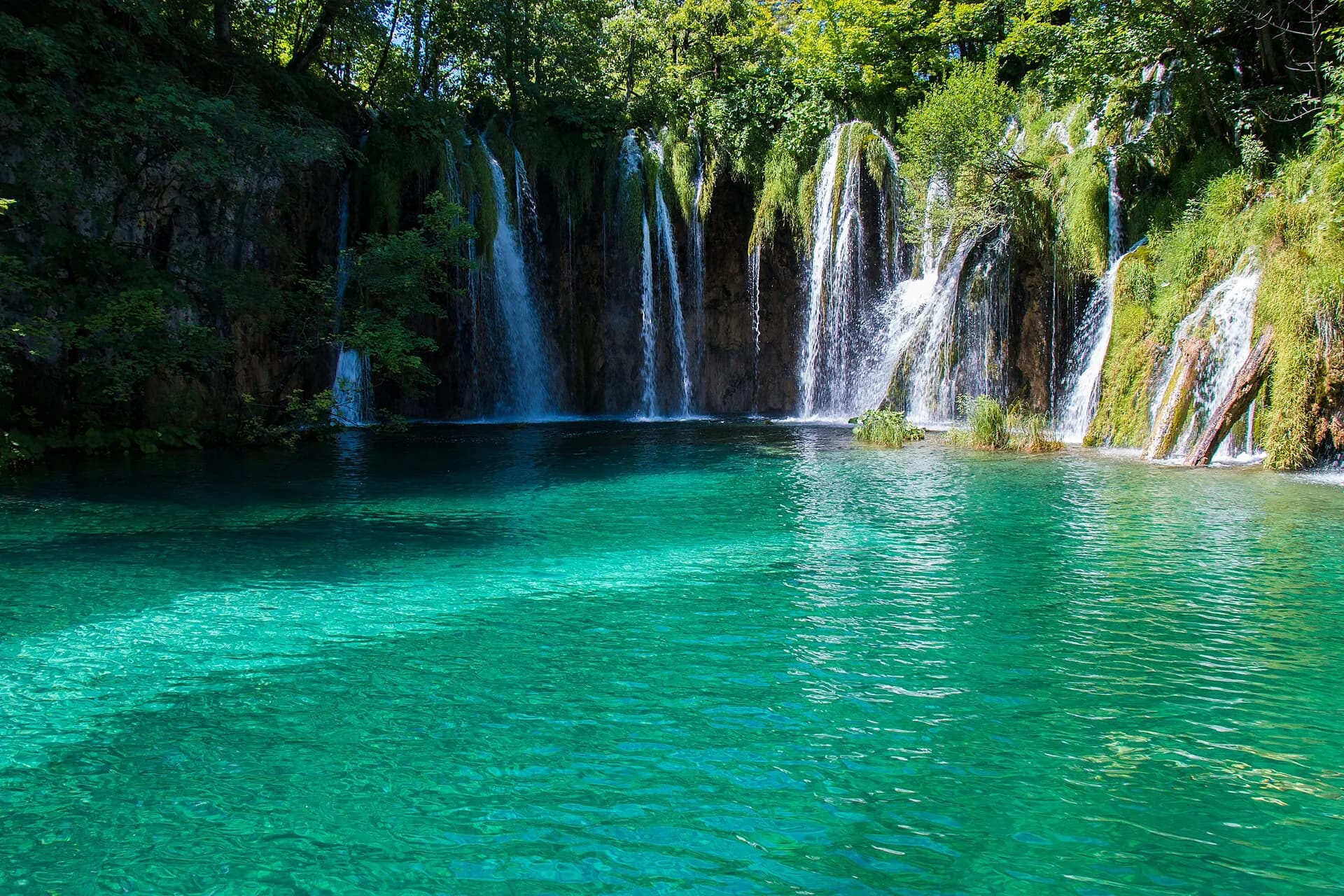
Plitvice Lakes, in the forested mountains of central Croatia, is the country's oldest and largest national park and one of the most beautiful natural sites in Europe. Sixteen lakes, coloured turquoise, emerald and blue depending on the minerals and light, step down a valley, separated by natural dams of travertine, a rock formed from calcium carbonate deposited by mosses and algae. Water spills between them in hundreds of waterfalls.
A network of wooden boardwalks and trails winds across and around the water, allowing visitors to walk just above the surface. The park is a World Heritage Site, and very popular in summer, so arrive early and choose your route carefully.
The top 7 in Plitvice Lakes National Park
- 1
Veliki slap (the Great Waterfall)
Photo: Falk2, CC BY-SA 4.0, via Wikimedia Commons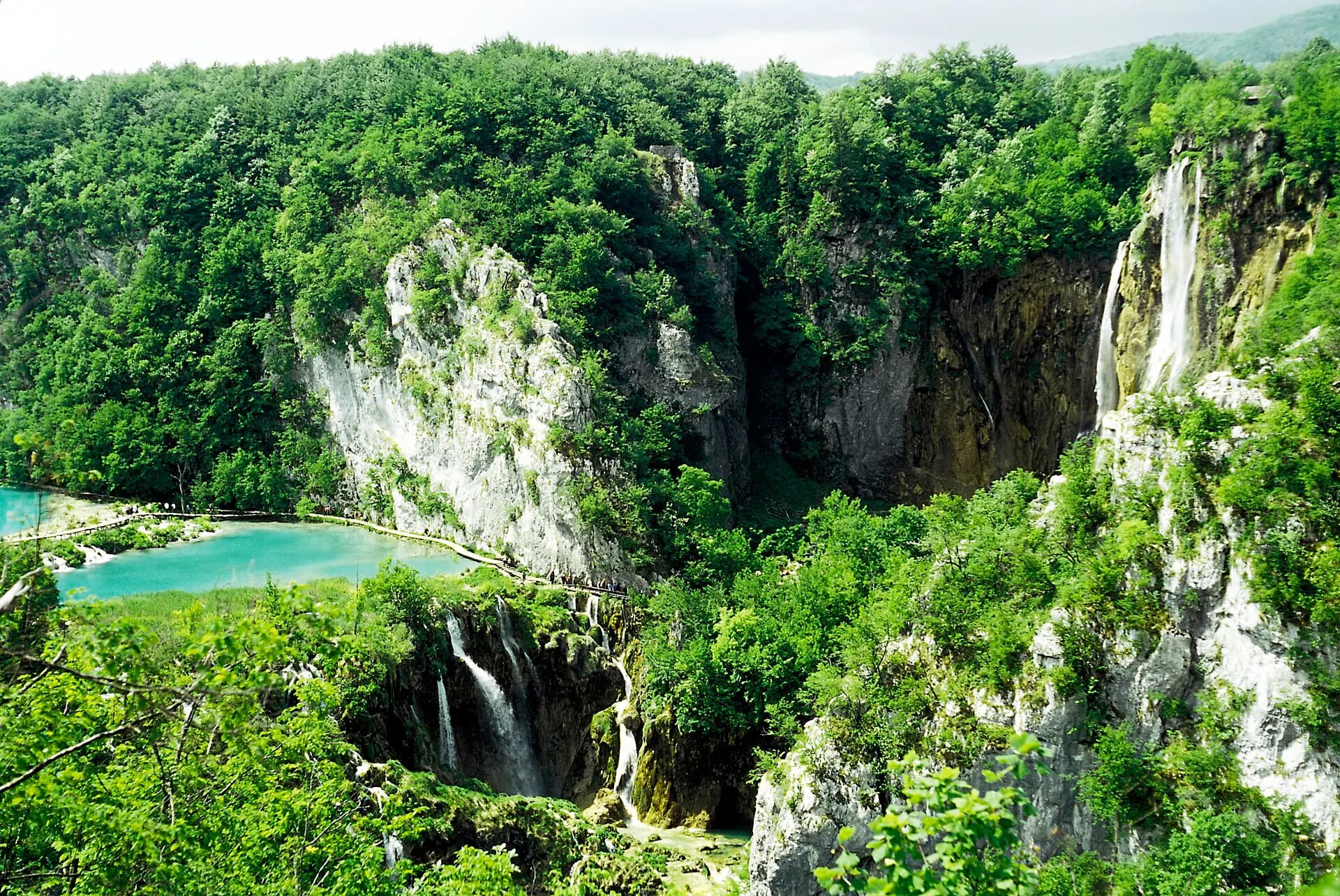
The highest waterfall in Croatia, falling around 78 metres from a cliff in the lower canyon, where the Plitvica stream plunges into the lakes. A viewpoint and path lead to its base.
- 2
The Lower Lakes
A canyon of smaller lakes between steep limestone cliffs, crossed by boardwalks and overlooked by viewpoints near Entrance 1, which give the most famous view of the park.
- 3
The Upper Lakes
Photo: Mark Ahsmann, CC BY-SA 3.0, via Wikimedia Commons
A series of larger lakes in a wider valley surrounded by forest, with cascades and boardwalks winding between them. They are often quieter than the Lower Lakes.
- 4
Lake Kozjak and the boat crossing
The largest lake, crossed by an electric boat between the two parts of the park, a welcome rest on longer routes.
- 5
The panoramic train
Electric road trains link the entrances and stations along the eastern rim of the valley, used on many walking routes to return to the start.
- 6
Galovac and the Upper Lakes cascades
A lake surrounded by many small waterfalls tumbling over mossy travertine, one of the prettiest corners of the upper valley.
- 7
The Šupljara cave
Photo: Jotkate, CC BY-SA 4.0, via Wikimedia Commons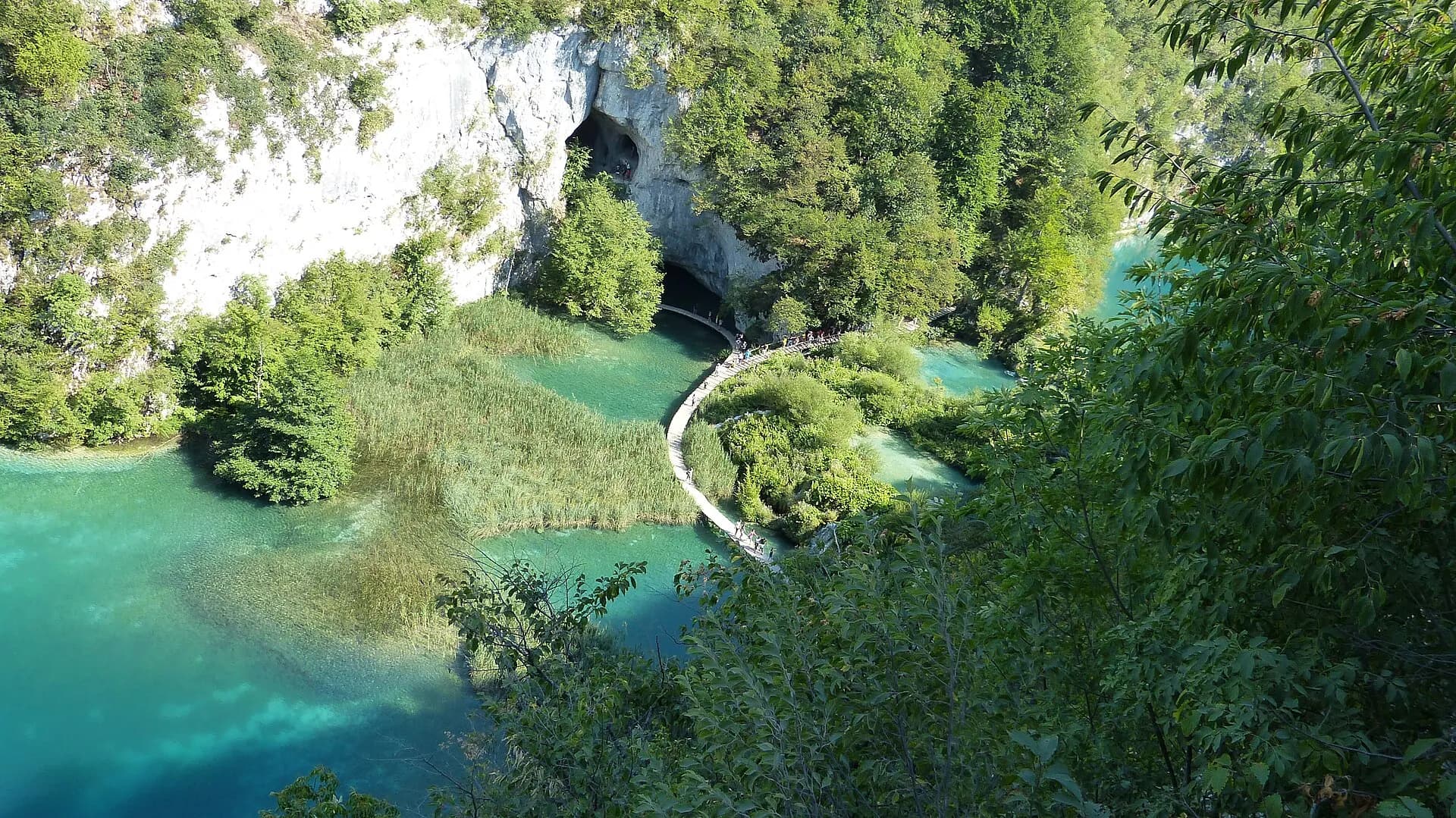
A small cave in the canyon above the Lower Lakes, reached by steps from the trail, with a view down over the water.
When to go
Late spring brings the fullest waterfalls and fresh green forests. Summer is the busiest season, with long queues and crowded boardwalks. Autumn brings spectacular colours and fewer visitors. In winter, the lakes may freeze and snow covers the park, which is beautiful but some routes are closed.
Getting around
The park has two main entrances. Entrance 1 is closest to the Lower Lakes and the Great Waterfall; Entrance 2 is near the hotels and the Upper Lakes. Several marked routes, from about two to eight hours, combine walking, the boat across Kozjak and the panoramic train. Buses link the park with Zagreb, about two hours away, and Zadar and Split on the coast.
Local tips
- Buy tickets online in advance in high season; entry is by time slot.
- Arrive at opening time to avoid crowds on the boardwalks.
- Swimming is not allowed in the lakes.
- Stay on the boardwalks and trails, and don't feed wildlife.
- Wear shoes with grip: the boardwalks can be wet and slippery.
- Allow at least half a day; a full day lets you see both sections.
- Drones are not allowed without a permit.
- Parking at both entrances is paid; arrive early in summer to find a space.
Eat and drink
Restaurants and kiosks in the park serve simple food, but bring snacks and water for longer routes. In the villages around the park, try lamb or veal cooked under a bell-shaped lid (peka), trout from local streams, and homemade cheese and cured ham.
Where to stay
Hotels inside the park, near Entrance 2, let you be first on the trails. Guesthouses and apartments in nearby villages such as Mukinje, Rastovača and Korenica are often good value, and many offer homemade breakfasts.
The park's natural history
The lakes are still growing: travertine barriers build up by a few centimetres every year as minerals settle on mosses and algae, creating new waterfalls and changing the shape of the lakes over time. The surrounding forests of beech and fir are home to brown bears, wolves, lynx and more than 150 species of birds, though large animals are rarely seen near the busy trails.
Beyond Plitvice
Rastoke, a village about half an hour north, has old water mills built over a series of small waterfalls where two rivers meet. The coastal towns of Zadar and Šibenik are a couple of hours away, and Krka National Park, with its own waterfalls, lies near Šibenik.
Choosing a route
The park marks its walking routes with letters, from A to K, which vary in length and in which entrance they start from. The shortest routes from Entrance 1 cover the Lower Lakes and the Great Waterfall in two to three hours. The longer routes, of six to eight hours, take in both the Lower and Upper Lakes, using the boat across Lake Kozjak and the panoramic train to return. In summer, a popular plan is to start at Entrance 2, take the train up to the top of the Upper Lakes and walk downhill through the whole valley, finishing at the Great Waterfall, which saves climbing and keeps you moving in the same direction as most of the water.
History
The lakes have attracted visitors since the nineteenth century, and the first hotel opened in 1896. The area became a national park in 1949 and was among the first sites in the world to be inscribed on the World Heritage List, in 1979. The first armed clash of the Croatian War of Independence took place here, at Easter 1991, and the park was placed on the list of World Heritage in Danger during the war before being restored.