Bruges
A medieval city of canals, swans and gabled houses, frozen in time when its harbour silted up.
- Best time to go
- April to June and September to October; December for the Christmas market
- Local time
- –
- Currency
- Euro (EUR)
- Reading time
- 4 min
- Language
- Dutch and French

In the Middle Ages, Bruges was one of the richest cities in northern Europe, a great trading port connected to the sea, where merchants from across the continent dealt in cloth, wool and luxury goods, and painters such as Jan van Eyck and Hans Memling worked for wealthy patrons. When its waterway to the sea silted up in the fifteenth century, trade moved to Antwerp and the city fell into a long sleep.
That decline preserved its medieval centre almost intact, and today its canals, cobbled lanes, market squares and Gothic buildings form a World Heritage Site. It's small and very popular with day-trippers, so stay overnight to enjoy it in the quiet of the evening and early morning.
The top 8 in Bruges
- 1
The Markt and the Belfry
Photo: Tim Adams, CC BY 3.0, via Wikimedia Commons
The main square, lined with colourful gabled guildhouses and café terraces, is overlooked by the Belfry, a thirteenth-century bell tower 83 metres tall. Climb its 366 steps for views over the red rooftops, past the carillon of 47 bells that rings out across the city.
TipVisitor numbers in the tower are limited; go early or book a time slot online.
- 2
The Burg
Photo: Dietmar Rabich, CC BY-SA 4.0, via Wikimedia Commons
A smaller, elegant square with the Gothic City Hall, one of the oldest in the Low Countries, with a magnificent Gothic Hall inside, and the Basilica of the Holy Blood, a twelfth-century chapel holding a relic said to contain drops of Christ's blood.
- 3
The canals and Rozenhoedkaai
Photo: Marc Ryckaert (MJJR), CC BY 3.0, via Wikimedia Commons
Bruges is laced with canals, crossed by stone bridges and lined with medieval houses and gardens. Rozenhoedkaai is the most photographed corner, with the Belfry rising behind the water. Boat trips leave from several jetties for a half-hour tour.
- 4
The Groeningemuseum
Photo: Marc Ryckaert, CC BY 3.0, via Wikimedia Commons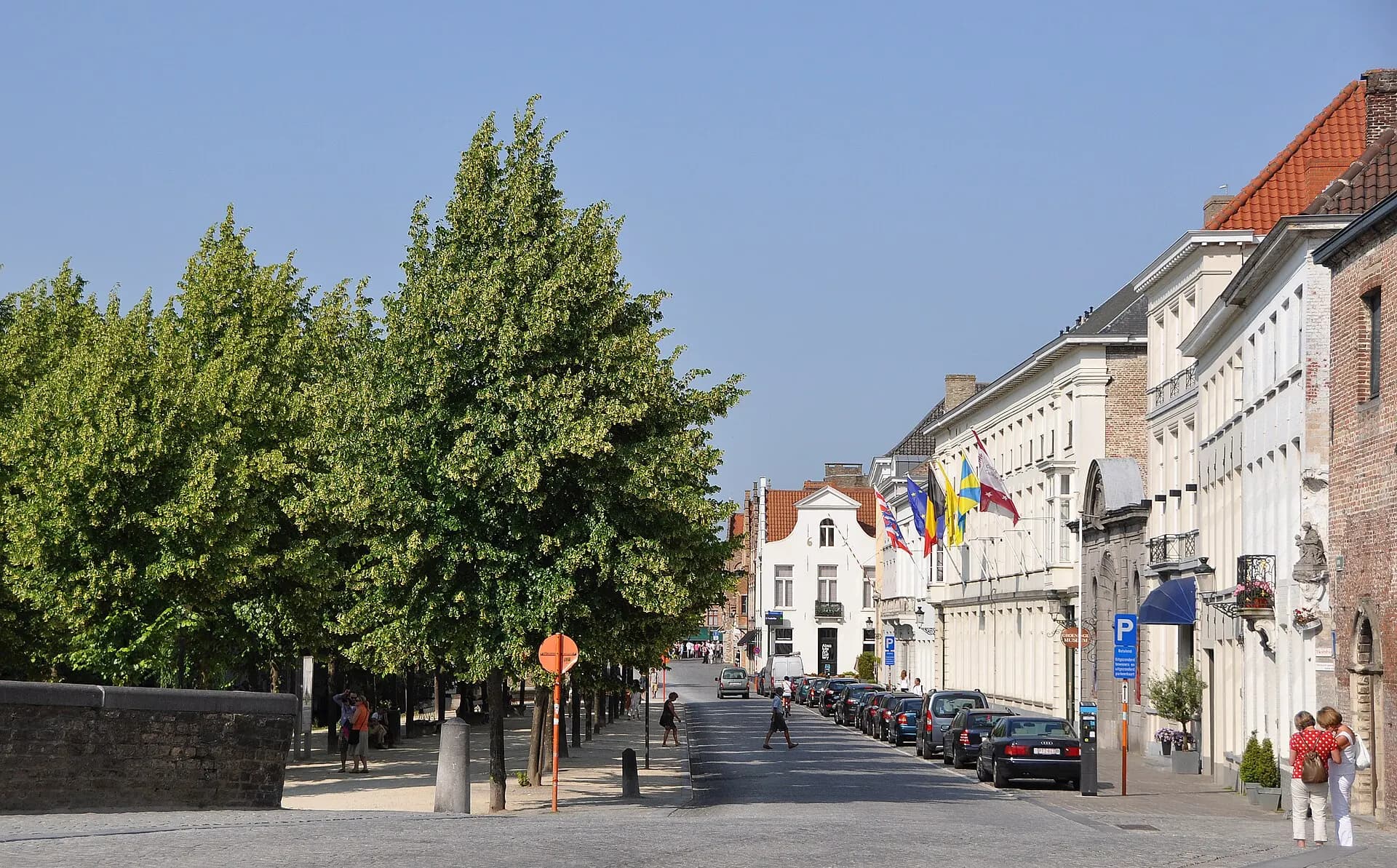
A museum of Flemish painting, with masterpieces of the fifteenth-century Flemish Primitives, including Jan van Eyck's Madonna with Canon van der Paele, as well as works by Hieronymus Bosch and later Belgian artists.
- 5
The Church of Our Lady
Photo: Giles Laurent, CC BY-SA 4.0, via Wikimedia Commons
A Gothic church with a brick spire more than 115 metres tall, one of the highest in Europe, holding Michelangelo's Madonna and Child, one of the few sculptures by the artist to leave Italy during his lifetime, as well as the tombs of Charles the Bold and Mary of Burgundy.
- 6
The Old St John's Hospital
Photo: CEphoto, Uwe Aranas, CC BY-SA 3.0, via Wikimedia Commons
One of Europe's oldest surviving hospitals, now a museum with a medieval apothecary, and the Memling museum in the chapel, holding six works by Hans Memling, including the painted Shrine of St Ursula.
- 7
The Beguinage and Minnewater
Photo: Marc Ryckaert, CC BY-SA 4.0, via Wikimedia Commons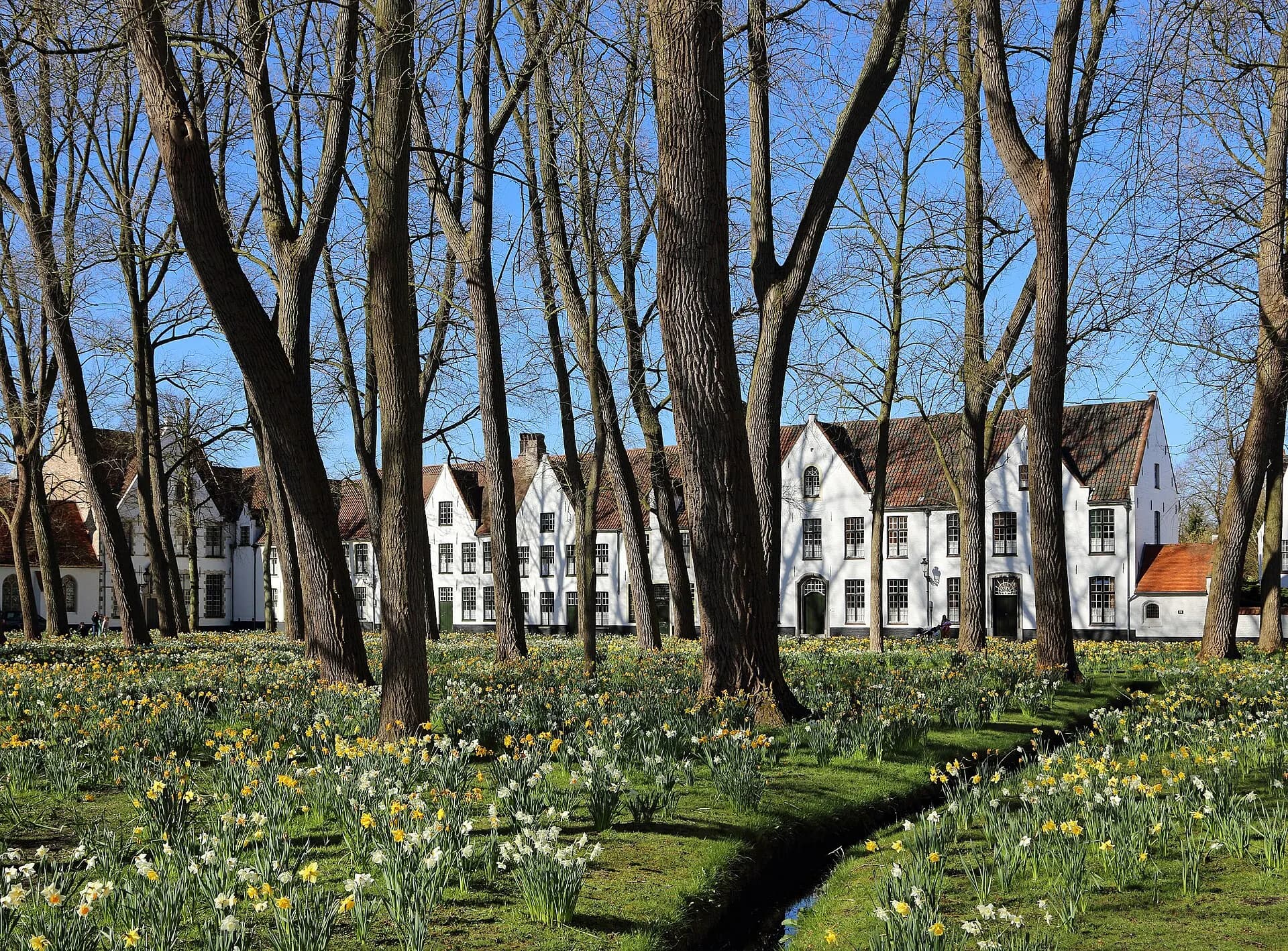
A peaceful walled enclave of whitewashed houses around a garden of trees, founded in the thirteenth century for beguines, religious women who lived in community; Benedictine nuns live here today. Just beyond is the Minnewater, the "Lake of Love", with swans.
- 8
The windmills of Kruisvest
Photo: Ermell, CC BY-SA 4.0, via Wikimedia Commons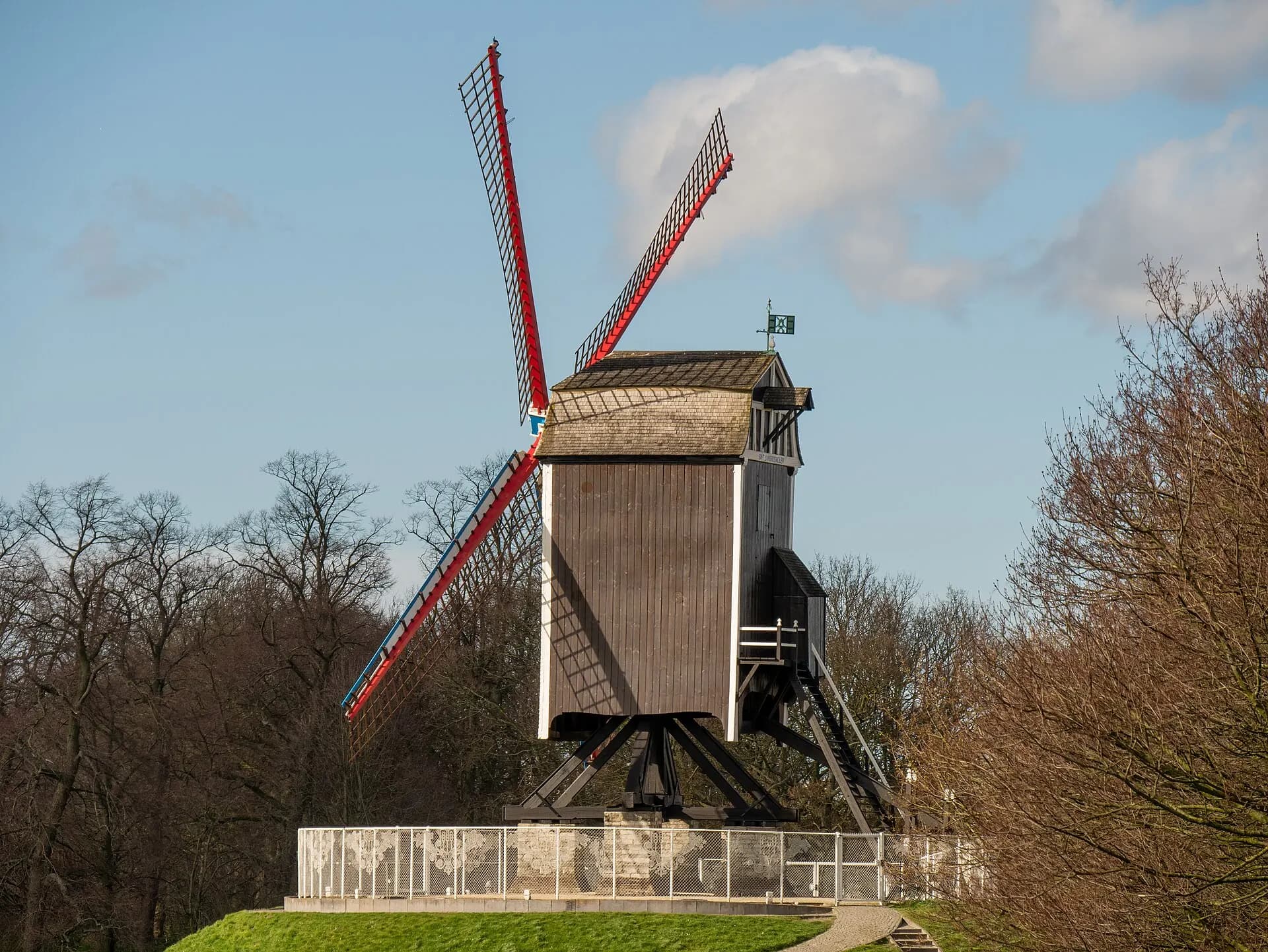
A green walk along the old city ramparts on the east side passes four windmills, one of which still mills grain and can be visited in season.
When to go
Spring and early autumn are the best times, with pleasant weather and fewer crowds than in July and August. December brings a Christmas market to the Markt and an ice rink. Bruges is busy with day-trippers from mid-morning to late afternoon all year, especially at weekends, so stay overnight if you can.
Getting around
The historic centre is small, car-free in parts and best explored on foot or by bike. Buses link the station with the centre, a ten- to fifteen-minute walk. Horse-drawn carriages tour the old town from the Markt.
Trains link Bruges with Brussels in about an hour, with Ghent in under thirty minutes, and with Brussels Airport.
Local tips
- Stay at least one night to see the city at its most peaceful.
- A Museum Pass covers several of the city's museums.
- Watch for cyclists, who have priority in many streets.
- Beware of tourist-trap restaurants on the Markt; eat a few streets away.
- Many museums are closed on Mondays.
- Tap water is safe to drink.
Eat and drink
Belgium's beers are world famous, and Bruges has many specialist bars serving hundreds of varieties, including Trappist beers brewed by monks. The De Halve Maan brewery, in the heart of the city, offers tours and has a beer pipeline running underground to its bottling plant outside the centre. Try moules-frites, mussels with chips; carbonnade flamande, beef stewed in beer; waffles; and, of course, chocolate from one of the many chocolatiers.
Day trips
Ghent, half an hour by train, is a lively university city with its own canals, a medieval castle and the famous Ghent Altarpiece by the van Eyck brothers in St Bavo's Cathedral. Damme, a pretty village a short bike ride along a tree-lined canal, has a Gothic town hall. The Belgian coast and the moving First World War sites of Ypres and Flanders Fields are within an hour or so.
Where to stay
Staying within the old city walls lets you experience Bruges in the evening and early morning, when the day visitors have gone and the canals are calm. Options range from boutique hotels in medieval houses to small family-run bed and breakfasts. The quieter streets of Sint-Anna, east of the centre, and the area around the Beguinage are particularly peaceful. Hotels near the station are a short walk from the centre and often cheaper.
Lace, chocolate and markets
Bruges has a long tradition of bobbin lace making, and the Lace Centre in the Jerusalem quarter holds demonstrations. Chocolate shops line the streets, and a chocolate museum, Choco-Story, explains its history. On Wednesday mornings, a market fills the Markt, and on weekends a flea market sets up along the Dijver canal.